





What's Happening?
German chipmaker Infineon Technologies has inaugurated a new manufacturing facility in Thailand, marking a significant investment in Southeast Asia's semiconductor industry. The facility, located near Bangkok, is a backend manufacturing site responsible
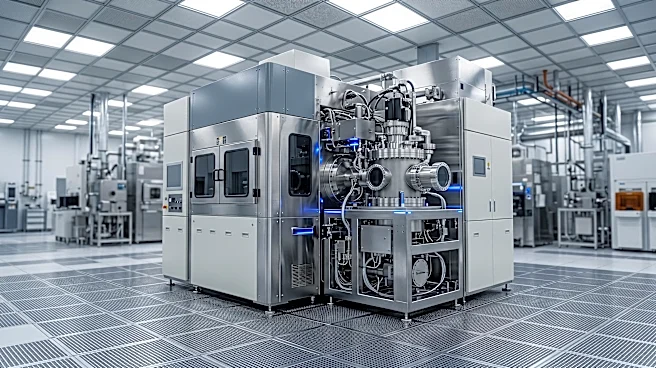
for processing chips into finished and tested semiconductors. Infineon's initial investment exceeds €100 million ($113.57 million), with the Board of Investment in Thailand valuing the overall project at $1.4 billion. The site will commence operations with 30,000 square meters of cleanroom space, with potential for expansion to 150,000 square meters. This expansion is part of Infineon's strategy to offer dual sourcing to its customers and capitalize on the booming demand for semiconductors, particularly those driven by artificial intelligence technologies. Thailand is actively seeking to attract $18 billion in semiconductor investments by 2030, focusing on photonics, power electronics, and sensors, and plans to train nearly 85,000 skilled workers and over 1,700 researchers for the sector.
Why It's Important?
This investment by Infineon is crucial for the global semiconductor supply chain and has implications for the U.S. technology sector. As global semiconductor sales are projected to reach $1 trillion this year and double to $2 trillion by 2035, driven largely by data centers powering AI, increased manufacturing capacity is vital. The U.S. relies heavily on a stable and diverse global semiconductor supply chain, and new facilities like Infineon's in Thailand contribute to this stability by reducing concentration risks. The dual-sourcing strategy employed by Infineon enhances resilience against potential disruptions, which is a key concern for U.S. businesses and consumers who depend on a steady supply of chips for various products. Furthermore, Thailand's push to develop its semiconductor industry aligns with broader efforts to diversify manufacturing hubs, potentially offering new opportunities for collaboration and investment for U.S. companies seeking to expand their global footprint and secure their supply lines.
What's Next?
Infineon's new facility is expected to ramp up production, contributing to the global supply of semiconductors, especially those critical for AI applications. This expansion will likely strengthen Thailand's position as a key player in the semiconductor manufacturing landscape, potentially attracting further foreign direct investment from other international chipmakers, including those with U.S. ties. The Thai government's commitment to training a skilled workforce and researchers will be crucial for the long-term success and growth of the sector. For the U.S., this development means a more diversified and potentially more resilient global semiconductor supply chain, which could mitigate some of the risks associated with geopolitical tensions or natural disasters in other major manufacturing regions. U.S. companies may explore partnerships or investments in Thailand to leverage the growing infrastructure and talent pool, further integrating the region into the broader U.S.-led technology ecosystem.
Beyond the Headlines
The opening of Infineon's plant in Thailand highlights a broader trend of semiconductor manufacturing decentralization and diversification, driven by geopolitical considerations and the increasing demand for chips across various industries, particularly AI. This move is not just about increasing capacity but also about building more resilient supply chains that are less vulnerable to single points of failure. For the U.S., this trend is significant as it seeks to reduce its reliance on a few key manufacturing hubs and promote a more distributed global production network. The investment also underscores the growing importance of Southeast Asia as a strategic region for high-tech manufacturing, offering an alternative to traditional centers. This shift could lead to new economic partnerships and technological collaborations, reshaping the global technology landscape and influencing future trade policies and investment strategies for U.S. companies and the government alike. The focus on AI-driven demand also signals a long-term commitment to supporting the foundational technology for future innovation.