







What's Happening?
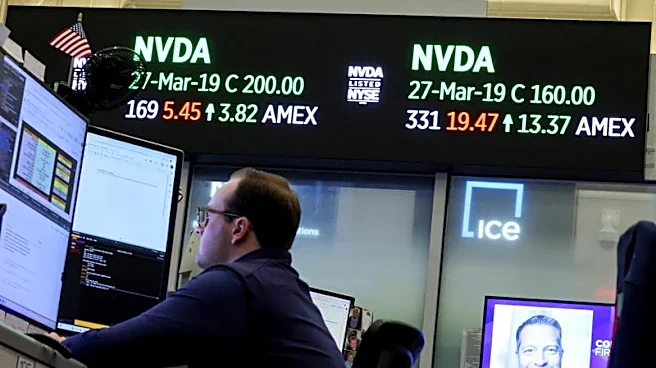
Bitcoin experienced a significant drop, falling below $60,000 on November 24, 2026, after a brief rebound that saw it approach $64,000. This decline occurred despite a substantial surge in Nvidia's stock, which gained 31.6% on November 23 following the
announcement of Jensen Huang's return to lead the company. The cryptocurrency's inability to sustain its gains, even with positive sentiment in the technology sector, reveals underlying vulnerabilities in the crypto market. According to the source, this includes a dependence on external catalysts, insufficient demand to maintain price levels, and a market susceptible to leverage, evidenced by over $850 million in liquidations across crypto markets within 24 hours. The macroeconomic environment, characterized by a firm dollar and anticipation of Federal Reserve decisions on monetary policy, further complicates the situation for risky assets like Bitcoin.
Why It's Important?
The recent performance of Bitcoin underscores the crypto market's sensitivity to broader financial conditions and its struggle to convert positive external news into sustained growth. The divergence between Nvidia's robust performance and Bitcoin's decline suggests that investor appetite for risk in the crypto space remains fragile. This situation is particularly important for U.S. investors and financial institutions involved in digital assets, as it highlights the challenges in predicting crypto market movements based solely on tech sector trends. The firm dollar and upcoming Federal Reserve decisions on monetary policy are significant factors, as they influence the attractiveness of riskier assets. If the Federal Reserve maintains a tight monetary policy, it could continue to suppress demand for cryptocurrencies, impacting investment strategies and market stability for U.S. stakeholders.
What's Next?
The immediate focus for the crypto market will be on Bitcoin's ability to regain and sustain levels above $65,000, which is identified as a critical resistance zone. According to Glassnode, this threshold is crucial for demonstrating that demand can absorb profit-taking from short-term holders. Failure to surpass this level could lead to continued concerns about the market's solidity. Additionally, upcoming inflation data and decisions from the Federal Reserve will be closely watched, as these macroeconomic factors are expected to heavily influence the trajectory of risky assets, including cryptocurrencies. Arthur Hayes, co-founder of BitMEX, suggests that a collapse in U.S. stock markets might paradoxically benefit cryptocurrencies by potentially forcing the Federal Reserve to inject more liquidity, a scenario historically favorable to speculative assets.
Beyond the Headlines
The contrasting performance between Nvidia and Bitcoin raises deeper questions about the nature of investment in the current financial landscape. While traditional tech stocks like Nvidia can experience significant gains driven by company-specific news, the crypto market appears to be grappling with a more fundamental issue of sustained demand and investor confidence. This situation highlights a potential shift in how different asset classes respond to market stimuli, suggesting that the 'rising tide lifts all boats' principle may not uniformly apply across traditional and digital assets. The ongoing debate about the Federal Reserve's role in market liquidity, as articulated by Arthur Hayes, points to a broader discussion about the interplay between monetary policy, traditional markets, and the nascent cryptocurrency ecosystem, and how these dynamics shape investor behavior and asset valuations in the long term.