





What's Happening?
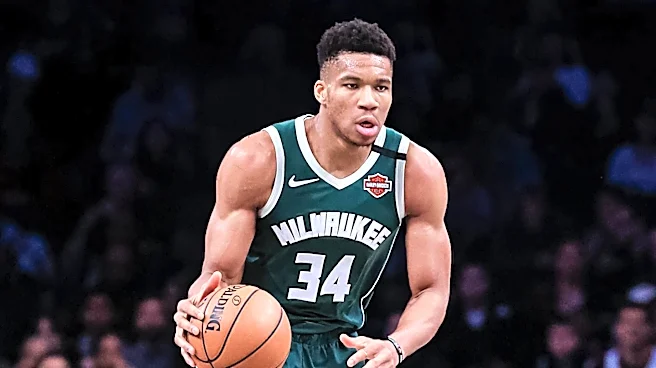
Former Milwaukee Bucks player Miroslav Raduljica has voiced his opinion on Giannis Antetokounmpo, stating that he does not consider Antetokounmpo an "extraordinary basketball talent." Raduljica, who played alongside Antetokounmpo in his early career,
acknowledged Antetokounmpo's strong work ethic but criticized his playing style, describing it as one-dimensional and overly reliant on physical dominance. He expressed that he finds Antetokounmpo's game, characterized by charging to the basket and jumping over opponents without a consistent jump shot or diverse offensive moves, to be "not basketball." Raduljica's comments, made on the Ozbiljno Neozbiljni podcast, suggest that Antetokounmpo's success is more a product of his hard work and the team's development plan rather than innate basketball skill. Despite his critique, Raduljica clarified that he meant no disrespect to Antetokounmpo.
Why It's Important?
This critique from a former teammate highlights a long-standing debate within basketball circles regarding the definition of "skill" versus "athleticism" in the NBA. Antetokounmpo's rise to superstardom, marked by multiple MVP awards and an NBA championship, has been largely attributed to his unparalleled physical gifts and relentless drive. Raduljica's comments, while controversial, underscore a purist's perspective that values traditional basketball skills like shooting, post-ups, and fakes over sheer physical power. This discussion is important as it touches upon how the game is evolving and what attributes are increasingly prioritized for success in modern basketball. It also brings to light the differing philosophies between European and American basketball development, with European systems often emphasizing fundamental skills from a young age. For fans and analysts, it prompts a re-evaluation of what constitutes an "elite talent" in today's NBA and how players like Antetokounmpo, who defy traditional molds, are perceived.
What's Next?
The comments from Miroslav Raduljica are likely to spark further discussion among NBA analysts, former players, and fans regarding Giannis Antetokounmpo's skill set and overall impact on the game. While Antetokounmpo has consistently demonstrated his ability to dominate, such critiques could fuel debates about the long-term sustainability of a game heavily reliant on physical attributes, especially as players age or face injuries. Antetokounmpo himself may choose to address these comments, or his performance on the court will continue to serve as his primary response. The ongoing evolution of his game, particularly his efforts to improve his mid-range and perimeter shooting, will be closely watched as he aims to diversify his offensive repertoire and counter such criticisms. The Milwaukee Bucks' strategy in surrounding him with complementary players, as seen in past successful seasons, will also remain a key factor in maximizing his effectiveness.
Beyond the Headlines
Beyond the immediate debate about Antetokounmpo's skills, Raduljica's remarks touch upon broader themes in professional sports: the role of physical prowess versus technical skill, the impact of coaching and development systems, and the subjective nature of evaluating talent. In an era where athletic freaks are increasingly common in the NBA, the question of whether a player's game is 'pure basketball' or simply a display of physical dominance becomes a philosophical one. This perspective also highlights the cultural differences in basketball, with European coaches often emphasizing fundamental skills and team play, while the NBA often celebrates individual athleticism and highlight-reel plays. The long-term implications could influence how young players are scouted and developed, potentially leading to a renewed focus on fundamental skills even for physically gifted athletes, ensuring a more well-rounded game that can adapt to various challenges, including injuries.