







What's Happening?
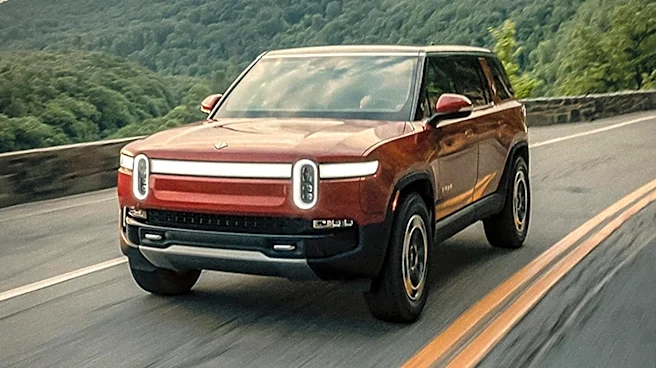
Rivian Automotive, Inc. (RIVN) announced record third-quarter deliveries of 19,248 vehicles, marking a 46% increase from the previous year and surpassing analyst expectations of approximately 18,000 units. This surge in deliveries follows the first full
quarter of R2 vehicle shipments, which began in June, leading to a 58% rise from the second quarter's 12,194 deliveries. Production at the Normal, Illinois plant reached 19,751 vehicles. Despite these strong delivery figures, Rivian has maintained its full-year guidance of 65,000 to 70,000 deliveries. Achieving the lower end of this guidance requires at least 23,193 deliveries in the fourth quarter, representing a 20.5% sequential increase. The company also reported that its automotive gross profit remained negative at $36 million in the second quarter, while software and services revenue increased by 37% to $515 million, largely driven by its joint venture with Volkswagen Group. Rivian's stock closed at $12 on October 27, down 28.3% over three months and near its 52-week low.
Why It's Important?
The record delivery numbers for Rivian are a critical indicator of its production ramp-up and growing market presence in the electric vehicle sector. Surpassing analyst estimates for deliveries demonstrates the company's ability to meet increasing demand and scale its manufacturing operations, particularly with the introduction of the R2 model. However, the market's muted reaction, with the stock trading down, highlights investor concerns about profitability and future growth. The continued negative automotive gross profit, despite increased revenue from software and services, suggests that Rivian is still struggling to achieve cost efficiencies in its core vehicle manufacturing. This financial challenge is further underscored by the company's revised outlook, no longer expecting positive adjusted EBITDA in 2027 due to increased investment in autonomy. The substantial investment from Volkswagen, including a $1 billion loan, provides Rivian with crucial capital but also places pressure on the company to demonstrate a clear path to profitability, especially as the market scrutinizes its ability to make money on each vehicle sold.
What's Next?
Rivian's upcoming third-quarter report will be closely watched for further details on its financial performance, particularly regarding automotive gross profit and its trajectory towards positive margins. Investors will be looking for signs that the company is making progress in reducing production costs for its R2 model, which CFO Claire McDonough previously stated should cost less than half as much as the R1 to build once output reaches a higher run rate in 2027. The market will also be keen to understand the implications of Rivian's increased autonomy spending and its acquisition of Third Dimension AI on its financial outlook and product development roadmap. The company's ability to meet its full-year delivery guidance will be a key performance metric, requiring a significant increase in fourth-quarter deliveries. Furthermore, the ongoing partnership with Volkswagen and any potential shifts in Volkswagen's reliance on Rivian's software, particularly in light of Volkswagen's exploration of Xpeng EV software for its European lineup, could influence future collaborations and Rivian's software revenue streams.
Beyond the Headlines
The mixed market reaction to Rivian's record deliveries points to a broader challenge faced by many emerging electric vehicle manufacturers: the difficult balance between scaling production and achieving sustainable profitability. While Rivian has demonstrated its capability to produce and deliver vehicles at an increasing rate, the persistent negative automotive gross profit indicates that the company is still in a heavy investment phase, prioritizing market share and technological advancement over immediate financial returns. The strategic importance of software and services revenue, as highlighted by its growth and contribution to overall gross profit, suggests a potential shift in the EV business model, where recurring revenue streams from technology and services could become as crucial as vehicle sales. The acquisition of Third Dimension AI for autonomy development underscores the industry's race towards advanced driver-assistance systems and fully autonomous capabilities, which are seen as key differentiators and future revenue generators. However, the substantial capital required for these investments, coupled with market skepticism about long-term profitability, will continue to shape investor sentiment and Rivian's strategic decisions in the highly competitive EV landscape.