







What's Happening?
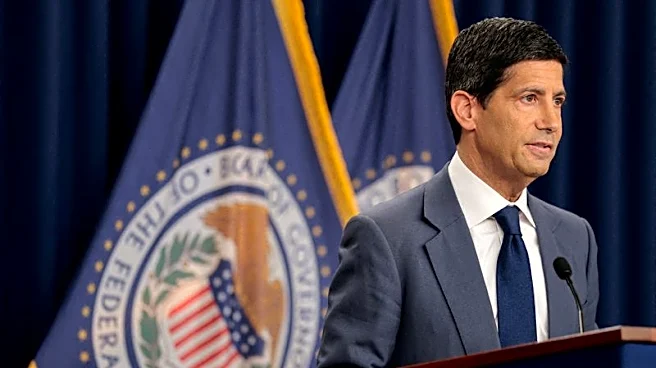
Robin Brooks, a senior fellow at the Brookings Institution, argues that Federal Reserve Chairman Kevin Warsh's recent policy decisions and mixed signals are primarily aimed at managing U.S. debt costs rather than solely controlling inflation. Brooks contends
that the traditional hawk-dove dichotomy does not accurately describe Warsh's approach. Despite recent inflation increases, Warsh has refrained from explicitly backing another rate hike, leading to a dovish market interpretation. Brooks suggests that the Fed and the Treasury Department are in a de facto agreement to stabilize borrowing costs. This perspective is supported by Treasury Secretary Scott Bessent's actions, such as buying back long-term bonds to lower yields and intervening in the currency market to support the yen, thereby preventing Japan from selling U.S. debt holdings that would increase yields. The U.S. national debt has surpassed $40 trillion, with publicly held debt at 100% of GDP, and debt-interest costs exceeded $1 trillion in fiscal year 2026, surpassing defense spending.
Why It's Important?
This interpretation by a Brookings Institution senior fellow highlights a significant shift in perceived Federal Reserve priorities, suggesting that the stability of U.S. debt markets may be taking precedence over traditional inflation targeting. If true, this could have profound implications for monetary policy, investor expectations, and the broader U.S. economy. A focus on yield curve management implies that the Fed might be less aggressive in raising interest rates, even in the face of rising inflation, to prevent a further escalation of the government's borrowing costs. This strategy could provide short-term relief for the Treasury but might risk embedding higher inflation if not carefully managed. For consumers and businesses, this could mean continued price pressures but potentially more stable borrowing costs for mortgages and corporate loans. The precarious U.S. debt situation, with interest costs exceeding defense spending, underscores the urgency of managing these financial liabilities, making Brooks's analysis particularly relevant to understanding current economic policy.
What's Next?
The ongoing debate about the Federal Reserve's true objectives will likely continue to influence market behavior and policy discussions. If Brooks's assessment is accurate, future Fed communications and actions will be scrutinized not just for their impact on inflation, but also for their implications for Treasury yields and the national debt. Market participants will be closely watching for further signs of coordination between the Fed and the Treasury Department. Any re-escalation of geopolitical tensions, such as the Iran war, or signs of a continuously hot U.S. economy could put renewed upward pressure on oil prices and Treasury yields, challenging the Fed's ability to manage borrowing costs. Conversely, any economic slowdown or perceived instability in other major economies, like France's political turmoil, could alleviate some pressure on U.S. yields. The effectiveness of these yield management strategies will be a critical factor in the U.S. economic outlook.
Beyond the Headlines
The notion that the Federal Reserve is engaged in 'yield curve management' rather than solely focusing on inflation control raises fundamental questions about the independence of the central bank and the long-term sustainability of U.S. fiscal policy. This de facto accord between the Fed and the Treasury, if it exists, could blur the lines between monetary and fiscal policy, potentially leading to a less transparent and more politically influenced approach to economic management. Such a strategy could also set a precedent for future administrations to lean on the central bank to manage debt burdens, potentially undermining the Fed's credibility and its ability to independently pursue its dual mandate of maximum employment and price stability. The ethical implications of prioritizing debt cost management over inflation control could include a disproportionate impact on savers and those on fixed incomes, who would see their purchasing power erode more rapidly. This situation highlights the growing challenge of managing a massive national debt in an environment of rising interest rates.