






What's Happening?
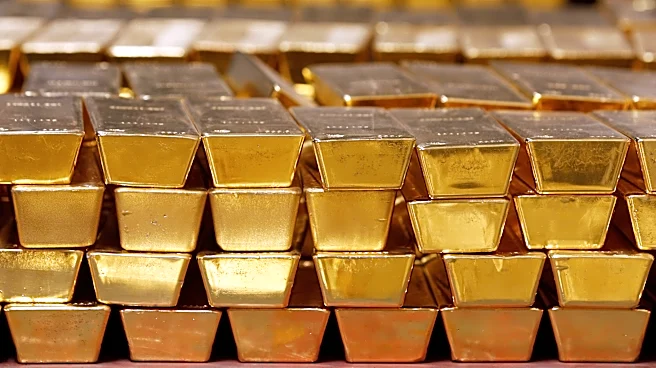
Central bank gold purchases saw a significant reduction in July, falling by 54% to 23 metric tons from 51 tons in June, according to the World Gold Council. This decline occurred even as gold prices remained near all-time highs. Despite the decrease in official-sector
acquisitions, the gold market remained resilient, largely due to a surge in investment demand. Physically backed gold ETFs worldwide attracted $3 billion in net inflows during July, effectively reversing two consecutive months of redemptions. These inflows led to a 23-ton increase in holdings, nearly matching the central bank buying for the month. European-listed funds were the primary drivers of this recovery, contributing to global year-to-date inflows of $11 billion, equivalent to a 39-ton rise in holdings. Asian-listed vehicles remained the largest contributors for the year, while North America continued to experience net outflows.
Why It's Important?
This shift in gold demand dynamics highlights a growing reliance on investor appetite rather than solely central bank purchases to underpin the market. For the U.S. and global financial markets, this indicates that gold's price stability and potential for appreciation are increasingly influenced by individual and institutional investment decisions, particularly through ETFs. The resilience of gold prices despite reduced central bank buying suggests that investors view gold as a valuable hedge against economic uncertainties or inflation, especially given the U.S. payroll figures that reignited rate worries. The continued net outflows from North American gold ETFs, in contrast to inflows elsewhere, could reflect differing regional investment strategies or perceptions of economic stability. This trend could also impact gold mining companies, as sustained investor demand could provide a more consistent floor for prices, potentially influencing exploration and production decisions.
What's Next?
The World Gold Council's outlook anticipates investment to be the primary driver of gold demand expansion for the remainder of 2026, even if full-year central bank purchases trail 2025. This suggests that the gold market's trajectory will largely depend on sustained investor interest and inflows into gold-backed products. If investor demand continues to rise, it could further decouple gold prices from central bank activity, making the metal more sensitive to broader market sentiment, inflation expectations, and geopolitical developments. The differing regional flows, particularly North America's net outflows, will be a key area to watch, as a reversal could significantly boost global demand. Additionally, the focus on where central banks store their gold, with some planning to diversify overseas or boost domestic storage, indicates evolving strategies in reserve management that could have long-term implications for gold's role in national economies.
Beyond the Headlines
The evolving composition of gold demand, with a greater emphasis on investor participation, points to a broader trend of financial market democratization and accessibility. Gold ETFs have made it easier for a wider range of investors to gain exposure to gold, moving beyond traditional physical holdings or direct central bank interventions. This shift could lead to increased volatility in gold prices, as investor sentiment can be more fluid than long-term central bank strategies. Furthermore, the discussion around central banks diversifying gold storage locations, as exemplified by the Netherlands relocating gold from North America, highlights underlying geopolitical and trust considerations. This could signal a move towards greater financial autonomy and reduced reliance on foreign custodians, potentially influencing international financial relations and the global distribution of gold reserves. The increasing importance of investor demand also underscores the metal's role as a perceived safe-haven asset in an era of economic uncertainty and fluctuating interest rates.