




What's Happening?
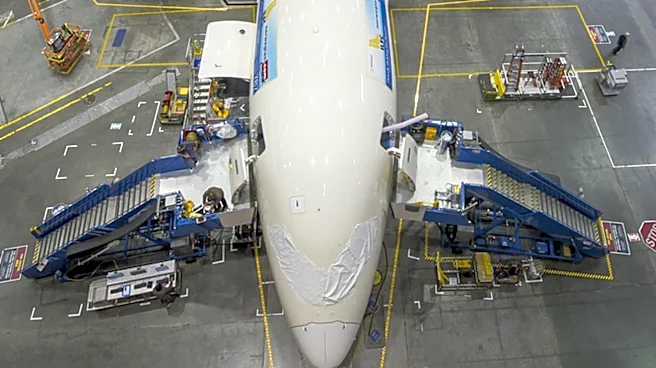
Boeing is experiencing significant production delays for its 737 and 787 aircraft lines, leading to missed delivery targets and a negative impact on its financial results. Management stated that stabilizing the 737 production rate at 47 airplanes per month
is taking longer than anticipated, now expected to extend into 2027. This slower progress means 737 deliveries for 2026 are projected to fall short of the 500-unit target. Similarly, the 787 program has also slipped, with 2026 deliveries expected to be at the lower end of its 90 to 100 range, primarily due to a shortage of GE Aerospace jet engines, a critical supplier. Boeing's Q3 2026 financial report showed revenue of $24.19 billion, missing consensus estimates by 1.5%, and a wider-than-expected loss of $0.34 per share. While profitability improved year-over-year due to the absence of a 777X program charge, the Commercial Airplanes revenue declined 3% from the previous year.
Why It's Important?
These production delays are critical for Boeing's financial health and its standing in the global aerospace market. Slower delivery rates directly impact revenue, as airlines pay a significant portion of the aircraft cost upon delivery. The inability to meet production targets can erode customer confidence, potentially leading to airlines considering competitors like Airbus for future orders. For investors, the extended timeline for stabilizing production and achieving higher rates introduces uncertainty and could continue to depress stock performance, as seen with the 10.7% drop in Boeing's stock after its Q3 2026 report. The reliance on key suppliers like GE Aerospace for engines highlights the fragility of complex global supply chains and how disruptions can ripple through major manufacturing industries. Boeing's goal of increasing annual cash flow to $10 billion by 2029 is directly tied to its ability to match aircraft deliveries with production rates, making these current delays a significant hurdle.
What's Next?
Boeing's management plans to fully test fixes for production issues before attempting to increase rates further. The company's financial plan targets a production rate of 52 airplanes per month in the second half of 2027. Detailed delivery plans by program for 2027 are expected to be released in January 2027, which will be a key indicator for investors and customers. The company is adding capacity where previous changes failed to yield intended savings. For the 787 program, the focus remains on addressing the GE engine shortage, which is currently the pacing item for reaching a rate of 10 aircraft per month. The Commercial Airplanes backlog reached a record $612 billion in Q3 2026, covering over 6,300 airplanes, indicating strong demand once production issues are resolved. However, the ability to convert this backlog into timely deliveries will be crucial for Boeing's recovery and future growth.
Beyond the Headlines
The ongoing production struggles at Boeing, particularly with its flagship commercial aircraft, point to deeper systemic challenges within the company's manufacturing and supply chain management. The repeated delays, despite management's efforts to implement changes, suggest that the issues are complex and may require more fundamental overhauls. This situation could lead to increased scrutiny from regulatory bodies and customers regarding Boeing's quality control and production efficiency. The competitive landscape with Airbus, especially in the narrowbody market, intensifies the pressure on Boeing to resolve these issues swiftly. Furthermore, the impact extends to the broader aerospace ecosystem, affecting suppliers, airlines, and the travel industry as a whole, which relies on timely aircraft deliveries for fleet expansion and modernization. The long-term implications could include a re-evaluation of manufacturing strategies, potentially leading to greater vertical integration or diversification of suppliers to mitigate future risks.