


What's Happening?
Infineon Technologies, a global semiconductor company, is strategically focusing on power solutions for Artificial Intelligence (AI) data centers as a key growth driver. Adam White, president of Infineon’s Power Systems division, outlined the company's
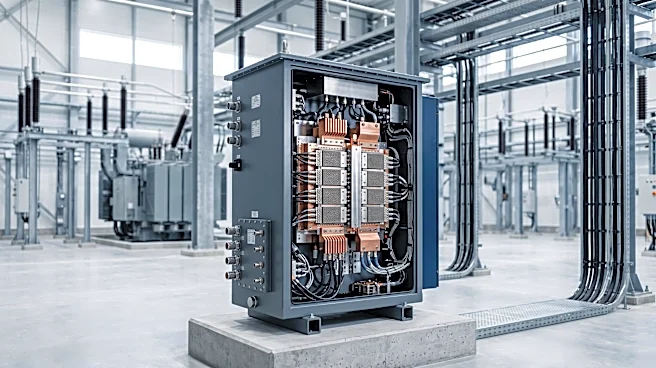
'From Grid to Core' power semiconductor strategy, emphasizing the significant expansion expected in the power semiconductor market. This growth is driven by the increasing electricity consumption of AI data centers and their transition to 800-volt direct current (800VDC) architectures. Infineon has established partnerships with various companies, including U.S.-based DG Matrix, to supply silicon carbide (SiC) power semiconductors for solid-state transformers (SSTs). The company also acquired Indian startup C2i Semiconductors in August to enhance its digital controller capabilities for these advanced architectures. These collaborations and acquisitions are part of Infineon's broader effort to provide power semiconductors and reference designs across the entire AI data center power supply chain, from grid connections to server-level components.
Why It's Important?
The shift towards 800VDC architectures in AI data centers, championed by companies like Nvidia, is critical for managing the escalating power demands of Graphics Processing Units (GPUs). As GPU power consumption is projected to increase dramatically, traditional power systems face challenges in handling higher currents and heat at lower voltages. The 800VDC architecture, by reducing conversion stages and heat generation, offers a more efficient and compact solution. Infineon's involvement, particularly through its partnership with U.S.-based DG Matrix for SiC power semiconductors, positions it as a crucial enabler of this technological transition. This development is vital for U.S. industries reliant on AI, as it directly impacts the efficiency, cost, and scalability of their data center operations. Companies that adopt these advanced power solutions stand to gain from reduced energy losses, lower operational costs, and improved performance of their AI infrastructure, while those that lag may face competitive disadvantages.
What's Next?
Infineon anticipates a significant increase in data centers' share of global electricity generation, rising from the current 3% to 7%–8% by 2030. Power consumption per server rack is expected to exceed 1 megawatt (MW) after 2028. The company is actively preparing for the mass production of solid-state transformers and is expanding its offerings to include three-phase 30kW power supply units (PSUs), 800V battery backup units (BBUs), and intermediate bus converters (IBCs). Vertical power delivery modules, designed to reduce voltage near GPUs, are scheduled for release in 2027. Infineon projects substantial revenue growth from AI data center power semiconductors, with targets of 1.5 billion euros for fiscal 2026 and 2.5 billion euros for fiscal 2027, with a revised forecast of over 1.6 billion euros for fiscal 2026. Further updates on these targets are expected at the company's upcoming earnings presentation.
Beyond the Headlines
The rapid evolution of AI data center power solutions, driven by companies like Infineon and its partners, highlights a broader trend towards energy efficiency and sustainability in the technology sector. The adoption of 800VDC architectures and solid-state components not only addresses the immediate power demands of AI but also contributes to reducing the environmental footprint of data centers. This technological shift could lead to new industry standards for power delivery and management, influencing future infrastructure development and investment. The increasing reliance on advanced semiconductors for critical infrastructure also underscores the importance of a robust and secure supply chain for these components, potentially impacting national security and economic competitiveness. Furthermore, the continuous innovation in power management for AI could accelerate the development and deployment of more powerful and energy-intensive AI applications across various sectors.