


What's Happening?
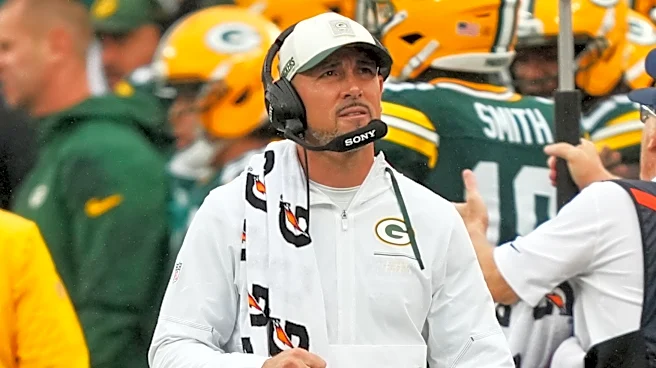
Green Bay Packers head coach Matt LaFleur has voiced strong dissatisfaction with the team's performance on third downs, labeling it as 'disgusting.' The Packers currently hold the worst third-down conversion rate in the league at 19.1 percent. LaFleur highlighted
that a significant portion of these struggles stems from facing long-yardage situations, often described as 'third-and-10 every time.' This issue is compounded by the team's poor first-down production, averaging only 3.0 yards per first-down play, which ranks 30th in the league. While the Packers have shown some efficiency on second downs, this has not consistently translated into manageable third-down opportunities. Quarterback Jordan Love's performance on third downs has also been a concern, with a low completion rate and minimal yards per attempt. The team's offensive coordinator, Adam Stenavich, echoed LaFleur's sentiments, emphasizing the need for better execution on first and second downs to avoid challenging third-down scenarios.
Why It's Important?
The Green Bay Packers' persistent struggles on third downs are a critical impediment to their offensive success and overall team performance. A low third-down conversion rate directly impacts sustained drives, reduces scoring opportunities, and places increased pressure on the defense. For a team aiming for playoff contention, the inability to convert on crucial downs can be the difference between wins and losses. The emphasis on 'third-and-10 every time' indicates a systemic issue originating from inefficient play on earlier downs, suggesting a need for fundamental adjustments in offensive strategy and execution. This situation affects not only the coaching staff and players but also the fan base, who expect a competitive product on the field. The team's performance in this area will be a key indicator of their potential to compete in the highly competitive NFL season, influencing everything from player morale to future roster decisions and coaching evaluations.
What's Next?
The Green Bay Packers face an immediate challenge to rectify their third-down issues as they prepare for upcoming games, including a matchup against the Atlanta Falcons, who boast a strong third-down defense. Coach LaFleur and offensive coordinator Stenavich will likely focus on improving first and second-down efficiency to create more favorable third-down distances. This could involve adjustments in play-calling, emphasizing shorter, higher-percentage plays, and improving execution in short-yardage situations. Quarterback Jordan Love will need to enhance his performance on third downs, potentially through more targeted practice and strategic adjustments to his decision-making under pressure. The team will also need to address penalty issues, particularly pre-snap infractions and holding calls, which often put the offense in disadvantageous positions. The coming weeks will reveal whether the coaching staff can implement effective solutions to this 'disgusting' problem and if the players can execute those adjustments on the field.
Beyond the Headlines
The Green Bay Packers' third-down struggles highlight a broader challenge in professional football: the intricate relationship between offensive efficiency, strategic play-calling, and player execution. While statistics like third-down conversion rates are often seen as isolated metrics, they are deeply intertwined with performance on every down. The team's difficulty in gaining sufficient yardage on first and second downs creates a cascading effect, forcing them into low-probability third-and-long situations. This scenario can erode team confidence, particularly for a young quarterback like Jordan Love, who is still developing. The pressure on LaFleur to address these issues extends beyond mere game strategy; it touches upon leadership, player development, and the ability to adapt in real-time. The long-term implications could include shifts in offensive philosophy, personnel changes, and a re-evaluation of coaching methodologies if the problem persists, underscoring how a seemingly specific statistical deficiency can reflect deeper operational challenges within a professional sports organization.