






What's Happening?
Garrett Brown, the inventor of the Steadicam, fundamentally transformed cinematography by enabling smooth, fluid camera movements previously unattainable with traditional equipment. Frustrated with cumbersome dollies and jerky handheld cameras, Brown spent
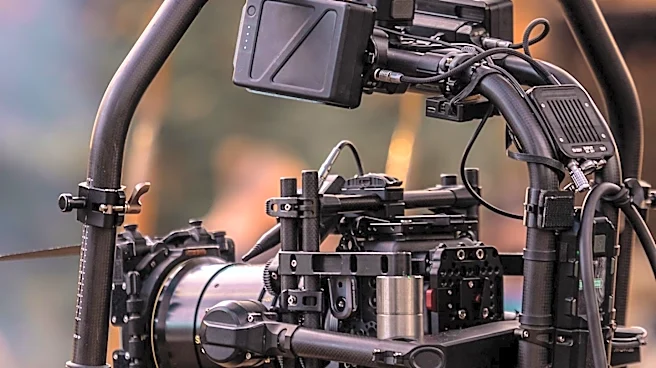
a week in 1974 developing the initial sketch for the Steadicam. His invention, which uses a harness and a gimbal to isolate camera movement from the operator's body, allowed for shots that mimicked natural human vision, which is inherently stable. Brown demonstrated the Steadicam's capabilities with '30 impossible shots' around Philadelphia, capturing the attention of filmmakers. The Steadicam gained widespread recognition for its use in iconic films such as 'Rocky,' where it captured the protagonist's sprint up the Philadelphia Art Museum steps, and later in Stanley Kubrick's 'The Shining' and 'Indiana Jones and the Temple of Doom.' Brown's innovation earned him an Oscar in 1978 and paved the way for further inventions like the Skycam for live sports.
Why It's Important?
The invention of the Steadicam by Garrett Brown is profoundly important to the film industry because it liberated cameras from static positions and rigid tracks, offering filmmakers unprecedented creative freedom. This technological leap allowed for dynamic, immersive storytelling by enabling the camera to move seamlessly through complex environments, follow characters closely, and capture action with a fluidity that deeply engages the audience. Before the Steadicam, achieving such shots was either impossible or required extensive, costly setups. Brown's invention democratized complex camera movements, making them accessible to a wider range of productions and influencing generations of cinematographers. Its impact extends beyond just aesthetics; it enabled new narrative possibilities, allowing directors to convey emotion and perspective through continuous, unbroken shots, thereby enhancing the audience's connection to the on-screen world. The Steadicam remains a vital tool in filmmaking today, a testament to its enduring significance.
Beyond the Headlines
Garrett Brown's journey from folk musician to groundbreaking inventor highlights the often-unconventional paths to innovation. His initial career in music, followed by a period of self-teaching in filmmaking, underscores how diverse experiences can converge to spark revolutionary ideas. The Steadicam's success also illustrates the principle of solving a persistent problem with an elegant, user-centric design. Brown's focus on replicating the natural stability of human vision, rather than simply stabilizing a camera, was key to its effectiveness and widespread adoption. Furthermore, his invention sparked a broader trend in the film industry towards developing specialized camera technologies to achieve specific visual effects, leading to innovations like the Skycam and other specialized rigs. This continuous pursuit of technological advancement in cinematography reflects a deeper desire to push the boundaries of visual storytelling and create increasingly immersive and realistic cinematic experiences for audiences.