
What's Happening?
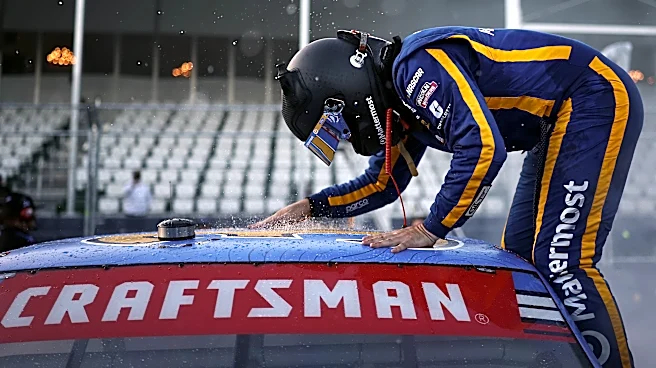
Kyle Larson has broken a significant 51-race winless streak by securing a victory at the Illinois 300, narrowly defeating his teammate Alex Bowman in overtime. This win marks a pivotal moment for Larson,
who, despite the long drought, has consistently demonstrated strong performance metrics, including high Driver Ratings and stage points throughout the season. His success at Bristol Motor Speedway, where he has multiple wins and top finishes, further highlights his capabilities. The recent victory at Gateway is attributed not only to Larson's driving skills but also to a cultural shift within Hendrick Motorsports, which has adopted a new data-sharing policy. This policy aims to enhance team performance by fostering greater transparency and collaboration among crew chiefs and drivers, a departure from previous practices where teams within the organization often kept strategies confidential. The change was prompted by the challenges posed by the Next-Gen car, which standardized parts and reduced the advantage of custom-built components, necessitating a more unified approach to overcome performance hurdles.
Why It's Important?
This victory and the underlying strategic shift at Hendrick Motorsports carry significant implications for NASCAR and the broader U.S. sports industry. The adoption of a data-sharing policy by a prominent team like Hendrick Motorsports could set a new precedent for how racing organizations approach competition in the Next-Gen car era. With standardized parts leveling the playing field, the emphasis shifts from proprietary technology to optimized data analysis and collaborative strategy. This could lead to a more competitive landscape across the sport, as teams that effectively leverage shared intelligence may gain an edge. For drivers like Larson, who previously relied heavily on raw talent, this new approach underscores the evolving demands of modern racing, where technical collaboration is as crucial as individual skill. The success of this model could influence other teams to re-evaluate their internal competitive dynamics, potentially fostering a more open and data-driven environment throughout NASCAR. This also highlights the adaptability required in professional sports to maintain competitiveness in the face of technological and regulatory changes.
What's Next?
Following this win, the immediate focus for Kyle Larson and Hendrick Motorsports will be to maintain this momentum and further validate the effectiveness of their new data-sharing strategy. The team's next test is at Bristol Motor Speedway, a track where Larson has previously shown dominance, leading for 284 laps in a prior race before ultimately losing. This upcoming race will be a crucial indicator of whether the collaborative approach can consistently translate into wins. If Hendrick Motorsports continues to perform strongly, it is likely that other NASCAR teams will closely observe and potentially emulate their data-sharing model. This could lead to a broader transformation in team dynamics and strategic planning across the sport. The transparency fostered within Hendrick Motorsports, even among drivers competing for the championship, suggests a long-term commitment to this new operational philosophy, aiming to maximize collective intelligence against external competitors rather than internal rivals.
Beyond the Headlines
The shift towards data-sharing at Hendrick Motorsports reflects a deeper trend seen across various high-performance industries, where collaborative intelligence and transparent information exchange are becoming critical for sustained success. In a sport like NASCAR, traditionally characterized by intense internal competition and proprietary knowledge, this move represents a significant cultural evolution. It challenges the long-held belief that secrecy among teammates is a competitive advantage, instead positing that collective problem-solving can yield superior results, especially when external factors (like the Next-Gen car's standardized parts) limit individual team advantages. This approach could foster a more integrated and efficient development process, potentially leading to faster innovation and adaptation to new challenges. The ethical dimension of this change involves balancing individual driver ambition with team-wide objectives, suggesting a redefinition of what constitutes 'teamwork' in a highly competitive individual sport. This model could also influence how data privacy and sharing are perceived and implemented in other competitive environments.