

What's Happening?
The New York Giants' run game is currently experiencing significant difficulties, described as a 'complete mess.' Despite improvements in other areas under Head Coach John Harbaugh, the team's rushing attack has declined from one of the NFL's most efficient
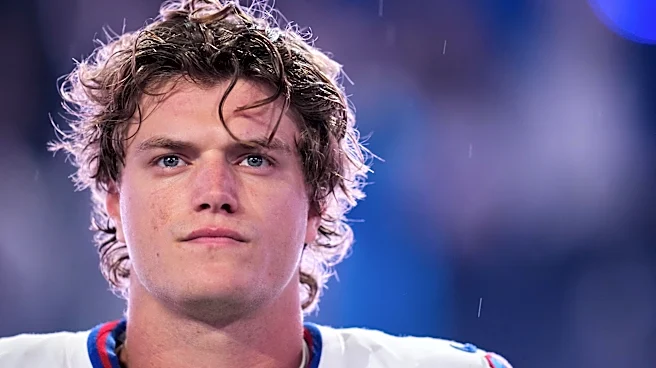
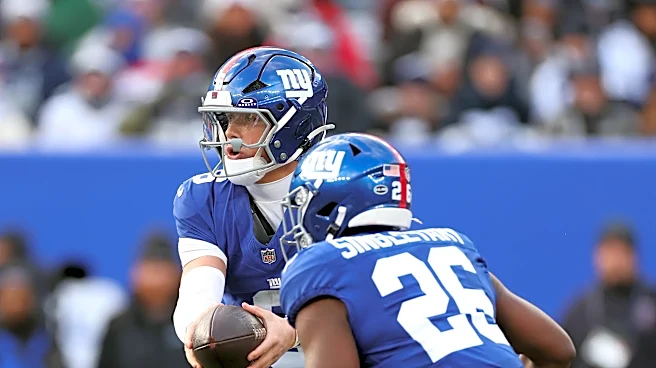
in 2025 to one of the least efficient in 2026. The primary running backs, Cam Skattebo and Tyrone Tracy Jr. (currently on injured reserve), along with Devin Singletary, constitute a similar running back room to the previous year, yet efficiency has dropped. The team is averaging just 3.9 yards per carry this season. This struggle is making it harder for the offense to move the ball and relieve pressure on quarterback J.J. McCarthy. The issues are not attributed to a single individual but rather to a collective failure involving coaching, offensive line performance, and personnel decisions.
Why It's Important?
The struggles of the New York Giants' run game have significant implications for the team's overall performance and strategic direction. A strong running game is crucial for controlling the clock, setting up play-action passes, and wearing down opposing defenses. Its current inefficiency places undue pressure on the passing game and quarterback J.J. McCarthy, potentially hindering his development and the team's ability to sustain drives. The lack of a true feature back, a departure from Harbaugh's previous success with players like Derrick Henry in Baltimore, highlights a critical personnel gap. Furthermore, the offensive line's poor run-blocking grade (49.6, third-worst in the NFL) indicates a fundamental weakness that impacts the entire offensive scheme. This collective failure could lead to continued offensive struggles, affecting the team's competitiveness and potentially influencing future coaching and roster decisions.
What's Next?
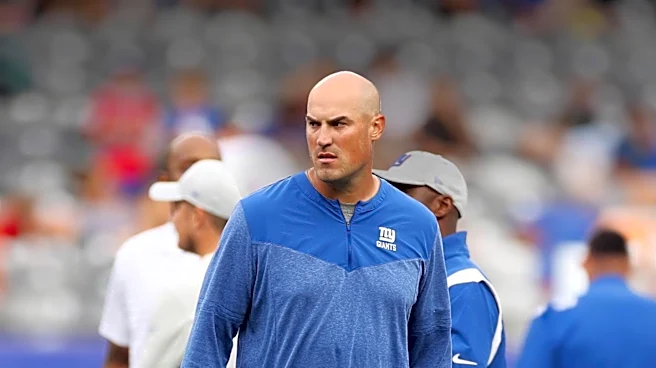
Addressing the New York Giants' run game issues will likely involve a multi-faceted approach. The team will need to evaluate the effectiveness of offensive coordinator Matt Nagy's run-scheming and the contributions of run game savant Greg Roman. Improvements in offensive line performance are critical, potentially through player development, strategic personnel changes, or adjustments to blocking schemes. Head Coach John Harbaugh may face pressure to be more aggressive in acquiring a marquee running back in future offseasons or trade deadlines, given the current running back room's limitations as committee backs rather than feature players. The team's ability to rectify these issues will be crucial for improving offensive consistency, taking pressure off the quarterback, and ultimately impacting their win-loss record in upcoming seasons.
Beyond the Headlines
The New York Giants' run game struggles underscore a broader challenge in modern NFL team building: balancing the investment in various offensive positions. The decision not to acquire a marquee running back, despite Head Coach Harbaugh's stated desire for a physical, run-heavy offense, suggests a potential misalignment between strategic vision and execution. This situation also highlights the increasing reliance on analytics and the de-emphasis of the 'feature back' role in some NFL circles, which may be proving costly for the Giants. The collective culpability, involving coaching staff, front office, and player performance, points to systemic issues rather than isolated failures. This could lead to a re-evaluation of the team's philosophical approach to offense and personnel acquisition, potentially influencing how other NFL teams assess the value of a dominant running game in an increasingly pass-heavy league.