


What's Happening?
Economist Stephen Miran, in his 2024 paper 'A User's Guide to Restructuring the Global Trading System,' has examined the intricate relationship between the U.S. dollar's overvaluation, American competitiveness, and its role as a reserve currency. The
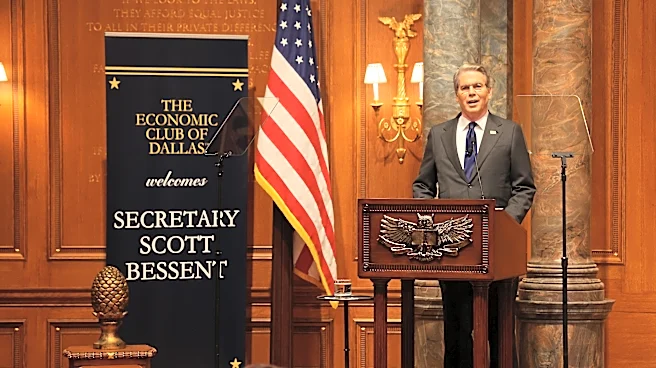
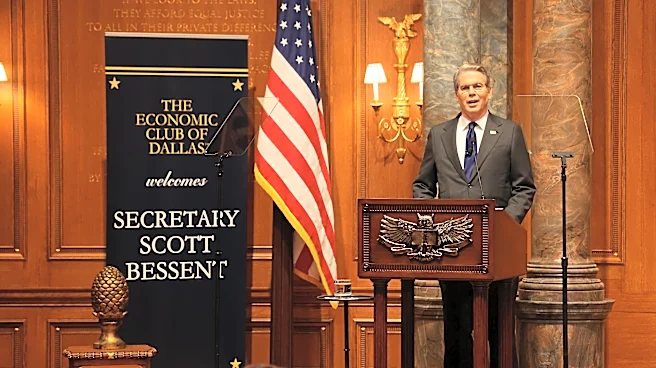
discussion now extends to the potential impact of stablecoins on this dynamic. According to the source, if global demand for digital dollars translates into increased demand for U.S. Treasury securities, it could provide Washington with an additional financing channel for its substantial debt burden. This development is framed within the context of the GENIUS Act, passed in July 2025, which established a regulatory framework for dollar-backed stablecoins. These stablecoins are required to maintain reserves in approved liquid assets, including short-term U.S. Treasury securities, thereby creating a mechanism where increased stablecoin circulation could drive demand for government debt. Treasury Secretary Scott Bessent has acknowledged this opportunity, suggesting stablecoins could become a significant source of demand for Treasury bills.
Why It's Important?
This exploration by Stephen Miran and the implications of the GENIUS Act are important for the U.S. financial landscape. The U.S. has historically benefited from its ability to borrow in its own currency, with global demand for Treasury securities financing its debt. However, with a growing debt burden, the sustainability of this model is a concern. Stablecoins, by potentially creating an automatic demand for U.S. debt through their reserve requirements, could offer a new, significant financing avenue. This could reduce reliance on traditional investors and potentially stabilize the market for U.S. Treasury securities. However, the source also raises a 'darker question' about the potential for financial repression, where the financial infrastructure itself could be redesigned to compel debt financing, shifting who finances the government, who captures interest, and who bears economic risks. This could have profound implications for financial freedom and the broader economy.
What's Next?
The ongoing evolution of the international monetary system, particularly with the integration of stablecoins, will be a key area to watch. The GENIUS Act's framework suggests a future where digital dollars are deeply embedded in various financial transactions, potentially making Treasury securities a major component of stablecoin reserves. Policymakers may introduce further regulations that favor these instruments, making demand for Treasuries less dependent on independent investor decisions. While the source clarifies that a compulsory digital-dollar system or sovereign-debt haircut is not current government policy, the gradual redesign of financial infrastructure could lead to subtle but significant shifts in how the government is financed. The long-term implications for the dollar's reserve currency status and the U.S. debt market will depend on how these mechanisms are implemented and regulated.
Beyond the Headlines
The deeper implications of stablecoins becoming a primary mechanism for financing U.S. debt touch upon fundamental questions of monetary control and financial autonomy. The source draws parallels to historical instances where governments altered monetary rules, such as the Roosevelt administration's restriction on private gold ownership in 1933 and Nixon's ending of the dollar's convertibility to gold in 1971. These historical events illustrate how governments can change the rules of the monetary system when it becomes unsustainable, often with significant consequences for individuals' financial lives. The concern is that a similar, albeit more subtle, shift could occur through the integration of stablecoins, where financial repression could be embedded within payment infrastructure rather than imposed through overt controls. This raises ethical and legal questions about the extent of government influence over private financial assets and the potential for a system where the 'money becomes the debt collector.'