






What's Happening?
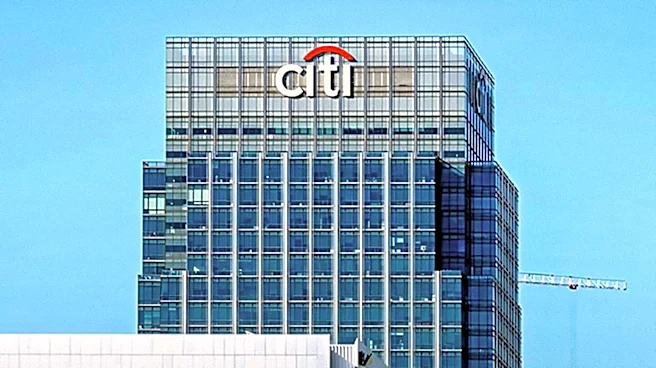
Citigroup Inc. has seen its stock price increase by 29.3% over the past six months, outperforming the industry's growth of 26.5%. This surge is attributed to the company's ongoing multi-year transformation strategy, which includes exiting non-core international
consumer banking businesses, implementing cost-cutting initiatives, and making significant technology investments. The company has completed the sale of its Polish consumer business and is progressing with the wind-downs of Banamex, with a full deconsolidation and IPO planned for early 2027. These strategic divestitures aim to simplify Citigroup's structure, release capital, and allow for a greater focus on higher-return segments such as Services, Markets, Banking, Wealth, and U.S. Consumer Cards. Citigroup is also executing a cost optimization strategy, targeting the elimination of 20,000 positions by the end of 2026 and investing an additional $5 billion in technology modernization, marketing, talent, and branch renovations between 2026 and 2028. These efforts are expected to generate $2-$2.5 billion in annualized cost savings by 2026.
Why It's Important?
Citigroup's strategic overhaul is crucial for its long-term profitability and competitiveness within the financial sector. By divesting non-core assets and streamlining operations, the company aims to achieve a return on tangible common equity (ROTCE) of 10-11% by 2026, with further increases projected for 2027 and 2028. This transformation is designed to enhance shareholder value through improved operational efficiency and a more focused allocation of capital. The company's commitment to shareholder returns is also evident through its dividend growth and a substantial $30-billion share repurchase program, with $26 billion remaining available. Despite the recent stock rally, Citigroup continues to trade at a valuation discount compared to its peers like Bank of America and Wells Fargo, suggesting that the market may still be underpricing its future earnings potential. The successful execution of these strategies could lead to sustained growth and a stronger market position for Citigroup.
What's Next?
Citigroup plans to complete the deconsolidation and IPO of Banamex in early 2027, which is expected to free up an additional $5 billion in capital. The company will continue its cost optimization efforts, aiming to eliminate 20,000 positions by the end of 2026 and achieve $2-$2.5 billion in annualized cost savings. Investments in technology and artificial intelligence will also continue, with an incremental $5 billion allocated between 2026 and 2028 to modernize infrastructure and support revenue growth. Management anticipates net interest income (NII), excluding Markets, to increase by 5-6% in 2026, driven by loan growth and stabilizing funding dynamics. Analysts expect strong earnings growth, with a 40.5% year-over-year increase this year, followed by a 15.6% rise in 2027. The company's ongoing transformation and strategic investments are expected to drive further upside for its stock.
Beyond the Headlines
The ongoing transformation at Citigroup reflects a broader trend in the financial industry where large institutions are shedding non-core assets and focusing on digital transformation and efficiency to remain competitive. The emphasis on technology and AI investments highlights the increasing importance of these areas in modern banking, aiming to enhance operational resilience, improve productivity, and support revenue growth. The strategic shift also has implications for the global banking landscape, as Citigroup's exit from various international consumer markets allows it to concentrate resources on key growth areas and potentially expand its digital payment strategies, as seen with its plans to introduce tokenized deposit services in Japan. This strategic realignment could set a precedent for other global banks looking to optimize their portfolios and adapt to evolving market demands and technological advancements.