






What's Happening?
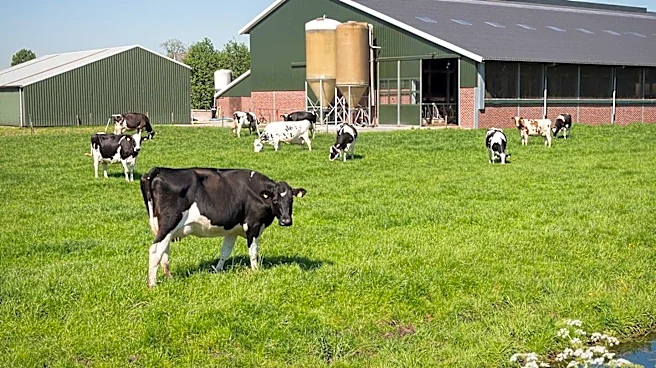
General Mills has initiated a three-year regenerative dairy pilot program in Michigan. This initiative is a collaborative effort with Foremost Farms and Understanding Ag, aiming to advance regenerative agriculture practices on one million acres of farmland.
The Yoplait brand, a part of General Mills, is actively supporting this commitment. Regenerative agriculture focuses on improving soil health, biodiversity, and water quality, which are crucial for sustainable food systems. This pilot program signifies a tangible step by a major food corporation to integrate environmentally friendly practices into its supply chain, specifically targeting dairy farming. The collaboration with Foremost Farms, a dairy cooperative, and Understanding Ag, an agricultural consulting firm, suggests a comprehensive approach to implementing and monitoring these new farming methods.
Why It's Important?
This pilot program is significant for several reasons. For the U.S. agricultural sector, it represents a growing trend towards sustainable farming practices, potentially influencing other large food producers to adopt similar models. Regenerative agriculture can lead to improved soil fertility, reduced reliance on synthetic inputs, and enhanced ecosystem services, which are vital for long-term food security and environmental health. Economically, farmers participating in such programs might benefit from increased soil resilience, potentially leading to more stable yields and reduced input costs over time. For consumers, this initiative could eventually lead to more sustainably produced dairy products. General Mills' involvement, particularly with a prominent brand like Yoplait, highlights the increasing corporate responsibility and consumer demand for products with a lower environmental footprint. This move could also set new industry standards for dairy sourcing and production.
What's Next?
Over the next three years, the pilot program will focus on implementing and evaluating regenerative agriculture practices within Michigan's dairy farms. This will likely involve monitoring key metrics such as soil organic matter, water infiltration rates, and biodiversity indicators. The findings from this pilot will be crucial in determining the scalability and broader adoption of these practices across General Mills' supply chain and potentially the wider dairy industry. Success in Michigan could lead to the expansion of similar programs in other regions. Stakeholders, including environmental groups, agricultural organizations, and consumers, will likely be observing the outcomes of this initiative closely. The program's progress could also influence policy discussions around agricultural subsidies and incentives for sustainable farming.
Beyond the Headlines
Beyond the immediate environmental and economic impacts, this initiative touches upon the evolving relationship between large corporations and agricultural sustainability. It reflects a shift from purely extractive agricultural models to ones that prioritize ecological restoration and long-term viability. The involvement of a major brand like Yoplait also underscores the power of consumer demand in driving corporate change towards more ethical and sustainable practices. This pilot could serve as a model for how food companies can actively contribute to climate change mitigation and biodiversity conservation through their supply chains. It also raises questions about the role of technology and data in monitoring and verifying regenerative practices, and how these efforts can be transparently communicated to consumers. The success of such programs could redefine what 'sustainable' means in the context of large-scale food production.