



What's Happening?
Ørsted, a global leader in offshore wind development, announced a 19% year-on-year increase in EBITDA to 20.2 billion Danish kroner for the first nine months of 2026, excluding new partnership businesses and contract cancellation costs. The company's
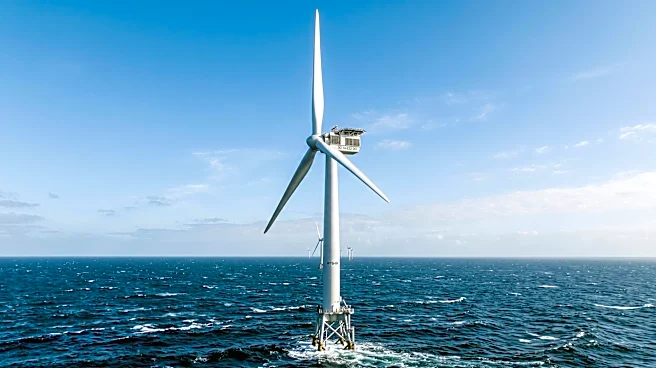
total installed renewable energy capacity has reached 19.5 GW, with power generation from offshore assets rising by 22% year-on-year. A significant development contributing to this growth is the commercial operation of the 704 MW Revolution Wind offshore wind farm in the U.S., located off New England, which began contributing power after being put into operation. Additionally, the Borkum Riffgrund 3 project in Germany has also started commercial operations. Despite positive profit growth, the company's adjusted Return on Capital Employed (ROCE) decreased to 7.4% from 10.2% in the same period last year, attributed to under-construction projects driving up occupied capital. Ørsted has also lowered its full-year gross investment guidance from 50-55 billion Danish kroner to 45-50 billion Danish kroner, citing changes in payment timing for some offshore wind projects.
Why It's Important?
The commercial operation of the Revolution Wind project in the U.S. signifies a crucial step in the expansion of renewable energy infrastructure in the country. This development contributes to the U.S.'s clean energy transition goals and enhances energy independence by diversifying the energy mix. For Ørsted, the successful execution of this project, alongside Borkum Riffgrund 3, demonstrates its ability to deliver on strategic priorities and maintain its presence in key markets, including the U.S., despite previous impairment losses on American projects in 2023. The increase in offshore power generation and EBITDA indicates a recovery phase for the company, which had previously undergone layoffs and a contraction of its market focus. However, the declining capital efficiency suggests that this recovery is capital-intensive, highlighting the financial challenges and significant investment required for large-scale renewable energy projects. The project's success could encourage further investment in U.S. offshore wind, benefiting local economies through job creation and infrastructure development.
What's Next?
Ørsted's immediate focus will be on continuing to deliver its 8.1 GW construction program on schedule and within budget. The company aims to maintain consistent, strong financial performance and sustain its presence in the wind energy sector. The reduction in gross investment guidance suggests a more cautious approach to cash outflow, potentially prioritizing the completion and optimization of existing projects over rapid expansion into new ventures. The company's strategy will likely involve a continued emphasis on core offshore wind markets, particularly in Europe, while carefully managing its retained, albeit narrowed, risk exposure in the U.S. and Asia-Pacific regions. Future financial reports will be closely watched to assess whether the company can improve its capital efficiency and identify new project reserves to ensure sustained growth beyond the current under-construction portfolio.
Beyond the Headlines
The co-occurrence of rising profits and declining capital efficiency for Ørsted points to a broader trend in the renewable energy sector: the increasing cost and complexity of developing large-scale projects. While the industry is crucial for combating climate change, the financial models and investment returns are under scrutiny, especially in the context of fluctuating interest rates and supply chain challenges. The shift in Nordic policy frameworks from 'subsidy-driven' to 'risk redistribution' indicates that governments are no longer providing unconditional underwriting, placing more financial responsibility on developers. This necessitates innovative revenue structures, such as Corporate Power Purchase Agreements and Contracts for Difference, to ensure project viability. The competition from Chinese wind turbine manufacturers, with their cost advantages, also highlights the global dynamics and the need for European developers like Ørsted to focus on project development, grid connection management, and long-term operations rather than solely on manufacturing. This evolving landscape demands greater discipline, stronger performance, and closer collaboration across the industry to support the expansion of offshore wind power.