






What's Happening?
AMD (AMD) stock remained flat after the company reported better-than-anticipated third-quarter results, exceeding both top and bottom-line expectations. The chipmaker announced earnings per share (EPS) of $2.09 on revenue of $13.38 billion, surpassing
analyst projections of $1.97 EPS on $13.08 billion in revenue. A significant driver of this performance was AMD's Data Center division, which saw its revenue surge by 97% year-over-year, reaching $8.5 billion, well above estimates of $8.19 billion. CEO Lisa Su attributed this growth to strengthening demand for Instinct and EPYC products, anticipating further acceleration in the fourth quarter. However, other segments showed mixed results; the Client business (PC sales) generated $2.9 billion, falling short of Wall Street's $3.06 billion expectation, and the gaming business revenue declined 40% year-over-year to $773 million, despite beating estimates of $655 million.
Why It's Important?
AMD's strong performance in its data center segment highlights the increasing demand for high-performance computing and artificial intelligence infrastructure, positioning the company as a key player in this rapidly expanding market. The substantial growth in data center revenue indicates a successful diversification strategy beyond its traditional PC and gaming markets, which are currently facing headwinds. The flat stock reaction, despite the earnings beat, suggests that investors may be weighing the impressive data center growth against the weaker performance in the client and gaming divisions, as well as broader industry challenges like rising memory costs affecting PC demand. This mixed investor sentiment reflects the complexities of the semiconductor industry, where strong performance in one segment can be offset by softness in others, impacting overall market perception and future growth expectations for the company.
What's Next?
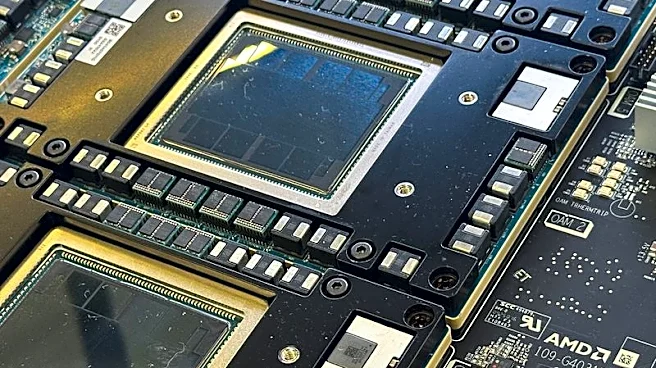
AMD anticipates continued growth acceleration in its data center segment in the fourth quarter as it scales production of its Helios and 'Venice' products. The company's focus on its leadership product portfolio and customer relationships aims to sustain strong revenue growth and expanding profitability in the coming years. However, the challenges in the PC market, driven by difficult year-over-year comparisons and increasing PC prices, are expected to persist. AMD's ability to further penetrate the data center and AI markets will be crucial for its future financial performance and stock valuation. Investors will be closely watching for continued momentum in its high-growth segments and any signs of recovery or stabilization in its client and gaming divisions, as well as how it navigates the competitive landscape against rivals like Intel.
Beyond the Headlines
AMD's earnings report underscores a significant shift within the semiconductor industry, where the data center and AI markets are becoming increasingly dominant growth drivers. The company's success in these areas reflects a broader technological transformation, as businesses and cloud providers invest heavily in advanced computing capabilities. This trend suggests a long-term structural change in demand for chips, moving away from traditional consumer electronics towards enterprise-level infrastructure. The challenges in the PC market, on the other hand, highlight the cyclical nature of consumer demand and the impact of macroeconomic factors on hardware sales. AMD's strategic pivot towards data centers and AI not only diversifies its revenue streams but also positions it at the forefront of critical technological advancements, potentially reshaping its market position and influence within the global tech ecosystem for years to come.