






What's Happening?
On November 5, Governor Spencer J. Cox announced that the Utah Division of Forestry, Fire and State Lands (FFSL) has selected Texas-based Mariana Minerals to redevelop the former U.S. Magnesium facility near Rowley, Tooele County. This decision follows
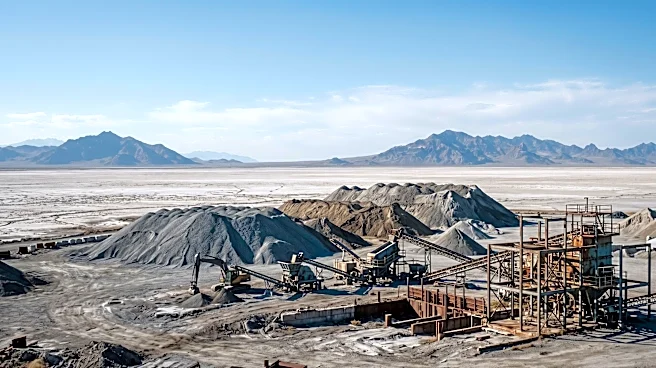
a competitive leasing process after Utah acquired the property and certain assets through federal bankruptcy proceedings earlier this year. The former industrial site, located along the southwestern shore of the Great Salt Lake, has a history of environmental contamination and was added to the Superfund National Priorities List in 2009 by the EPA. Mariana Minerals plans to introduce new mineral extraction technologies, initially focusing on recovering minerals from existing stockpiles. The long-term goal includes producing lithium and magnesium using processes designed to reduce water consumption and environmental impact. The state and Mariana Minerals still need to negotiate specific project terms, establish milestones, and determine the regulatory framework for future operations and cleanup, which will remain subject to state oversight and coordination with federal environmental regulators, including the EPA.
Why It's Important?
This redevelopment is significant for Utah as it addresses decades of environmental contamination at a Superfund site while simultaneously aiming to create new economic opportunities for Tooele County. Governor Cox emphasized that selecting Mariana Minerals is a crucial step towards replacing a 'legacy polluter' with an operator committed to bringing new, environmentally protective technology to mineral extraction. The project is expected to generate significant revenue through royalties to the state, which can then be directed towards environmental remediation, reducing the financial burden on taxpayers. Furthermore, Mariana Minerals has indicated plans to create over 200 full-time jobs, work with local contractors and businesses, and partner with universities and trade schools to develop a skilled workforce. The proposed use of lower-water mineral processing technologies is particularly important given the Great Salt Lake's critical water resources, with initial plans focusing on existing stockpiles to avoid immediate additional water draw.
What's Next?
The immediate next steps involve negotiations between the State of Utah and Mariana Minerals to finalize specific project terms, establish operational milestones, and define the regulatory framework for future operations and environmental cleanup. This process will ensure that the redevelopment aligns with both economic development goals and stringent environmental protection standards. The project will continue to be subject to state oversight and coordination with federal environmental regulators, including the EPA, to monitor progress and ensure compliance. Mariana Minerals will also need to begin implementing its plans for mineral recovery, starting with existing stockpiles, and gradually work towards the production of lithium and magnesium. The company's commitment to a long-term goal of net-neutral water use, if additional water resources are eventually needed, will be a key aspect to monitor as the project progresses.
Beyond the Headlines
The redevelopment of the former U.S. Magnesium site represents a broader trend in addressing industrial legacy pollution through innovative economic solutions. By acquiring the contaminated property and then strategically selecting a private operator with advanced technologies, Utah is attempting to transform an environmental liability into a sustainable economic asset. This approach could serve as a model for other states grappling with similar challenges, demonstrating how public-private partnerships can drive both environmental remediation and regional economic revitalization. The emphasis on reduced water consumption and the potential for lithium and magnesium production also highlights the growing importance of domestic critical mineral supply chains and sustainable resource management in the face of increasing environmental concerns and global demand for these materials. The success of this project could influence future policy decisions regarding industrial site cleanup and resource extraction.