
What's Happening?
SambaNova and Intel are collaborating to showcase an air-cooled inference approach designed to mitigate the significant costs and delays associated with retrofitting existing air-cooled data centers for
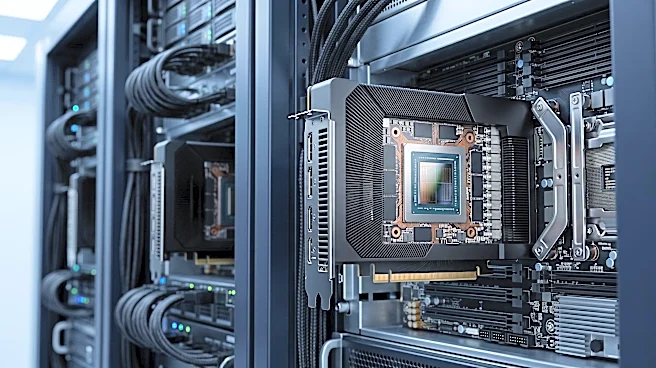
liquid-cooled AI systems. Many current AI systems necessitate liquid cooling, which can lead to up to half of projects scheduled for 2026 facing delays due to the expense and complexity of facility upgrades. Their demonstrated solution involves Intel's 350 W D-Series GPUs handling the prefill stage of AI inference, while SambaNova's SN50 RDUs manage the decode process. These SN50 RDUs operate at a typical power consumption of 20 kW per rack, with 16 units per rack. A key aspect of this approach is the movement of the KV cache between the Intel GPUs and SambaNova RDUs over standard Ethernet connections. This integrated system aims to deliver high-performance inference capabilities without requiring extensive and costly cooling infrastructure overhauls.
Why It's Important?
This collaboration between SambaNova and Intel is significant for the AI industry, particularly for data center operators and businesses looking to scale their AI capabilities. The high power consumption and heat generation of advanced AI hardware often necessitate liquid cooling, which presents a substantial barrier to adoption for many existing data centers built for air cooling. By offering a viable air-cooled inference solution, SambaNova and Intel could significantly reduce the capital expenditure and operational complexities associated with deploying AI at scale. This innovation could accelerate the deployment of AI technologies across various sectors by making it more accessible and cost-effective. Companies that have invested heavily in air-cooled infrastructure stand to benefit by extending the lifespan and utility of their current facilities for AI workloads, potentially avoiding massive retrofit costs and project delays. This could also foster broader AI adoption by lowering the entry barrier for organizations with existing data center footprints.
What's Next?
The demonstration of this air-cooled inference approach by SambaNova and Intel suggests a potential shift in how AI infrastructure is deployed and managed. The next steps will likely involve further testing, optimization, and commercialization of this technology. Data center operators and cloud service providers will be closely evaluating the performance, efficiency, and scalability of this solution in real-world scenarios. If successful, this could lead to increased adoption of air-cooled AI inference systems, potentially influencing future data center design and upgrade cycles. Competitors in the AI hardware space may also be prompted to develop similar air-cooled solutions or enhance the efficiency of their existing liquid-cooled offerings to remain competitive. The broader industry will be watching to see if this approach can truly alleviate the bottlenecks currently faced by AI deployments due to cooling requirements, potentially setting a new standard for AI infrastructure.
Beyond the Headlines
The development of efficient air-cooled AI inference solutions like the one demonstrated by SambaNova and Intel has deeper implications beyond immediate cost savings. It addresses a critical sustainability challenge within the rapidly expanding AI sector. The energy consumption and environmental footprint of data centers are growing concerns, and reducing the need for complex, energy-intensive liquid cooling systems could contribute to more sustainable AI operations. Furthermore, this innovation could democratize access to advanced AI capabilities. Smaller enterprises or those in regions with less developed infrastructure might find it easier to deploy powerful AI systems without the prohibitive costs and specialized requirements of liquid cooling. This could foster innovation and competition by enabling a wider range of organizations to leverage AI, potentially leading to new applications and services that were previously economically unfeasible. The long-term impact could be a more distributed and resilient AI ecosystem, less reliant on highly specialized and expensive data center environments.