




What's Happening?
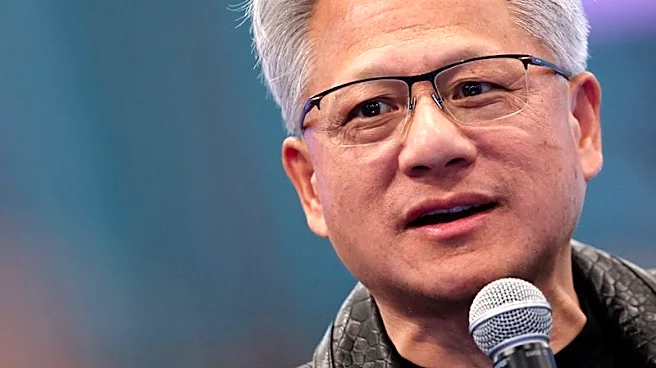
Jensen Huang has resigned from his positions as president, CEO, and director of Nvidia, effective immediately. The company announced his resignation on November 12, with the board accepting it on November 11. Following Huang's departure, CFO Colette Kress
has been appointed as the interim CEO, while also retaining her responsibilities in finance. The board has initiated a search for a permanent CEO, considering both internal and external candidates. Nvidia's regulatory filing indicates that the company expects operations, customer commitments, and the product roadmap to continue without interruption. Kress has emphasized the strength of Nvidia's employees and leadership team as crucial for the company's future phase, aiming to ensure continuity during this transition.
Why It's Important?
This leadership change at Nvidia is significant given Huang's pivotal role in establishing the company's dominance in the artificial intelligence sector. Nvidia's CUDA architecture, introduced in 2006, and subsequent developments like the DGX-1 in 2016, were instrumental in making its GPUs a preferred platform for deep-learning workloads. Huang's leadership fostered an extensive software ecosystem that made Nvidia's hardware accessible and widely adopted by researchers and developers. His departure raises questions about whether Nvidia's strategic advantage is deeply embedded within the organization or if it was overly reliant on his vision. The company's ability to maintain its innovation trajectory and market leadership in the rapidly evolving AI landscape without its founder will be a critical test, impacting its competitive standing against rivals who are constantly seeking to challenge its technological lead.
What's Next?
Nvidia's immediate priority is to ensure a seamless transition under interim CEO Colette Kress, maintaining operational stability, customer commitments, and the existing product roadmap. The board's search for a permanent CEO will be closely watched, as the selection will signal the company's future strategic direction. The market and stakeholders will be observing how effectively Nvidia's established engineering teams, software ecosystem, and customer relationships can sustain their momentum without Huang's direct leadership. The company will need to demonstrate that its strategy and innovation capabilities are institutionalized rather than dependent on a single individual, especially as the AI industry continues its rapid expansion and competition intensifies. The performance of Nvidia in the coming months will provide insights into its resilience and adaptability post-Huang.
Beyond the Headlines
Huang's resignation prompts a broader discussion about the role of visionary founders in technology companies and the challenge of succession planning. While Nvidia's technical infrastructure, including CUDA and its extensive developer tools, is robust and not tied to an individual, the strategic direction and ability to identify and capitalize on emerging opportunities often stem from strong leadership. The question of whether Nvidia's 'strategy belongs to the organization' or was 'dependent on his continued presence' highlights the delicate balance between founder-led innovation and institutionalized growth. This event could serve as a case study for other tech giants on how to manage transitions from iconic leaders, particularly in fast-paced, high-stakes sectors like AI, where continuous innovation and market adaptation are paramount. The long-term implications could influence how investors and the industry perceive the sustainability of innovation in companies with highly influential founders.