




What's Happening?
Fidelity Digital Assets has released its Q4 2026 Signals Report, providing an in-depth analysis of cryptocurrency market trends, investor sentiment, and the performance of key digital assets like Bitcoin, Ethereum, and Solana. The report, discussed by
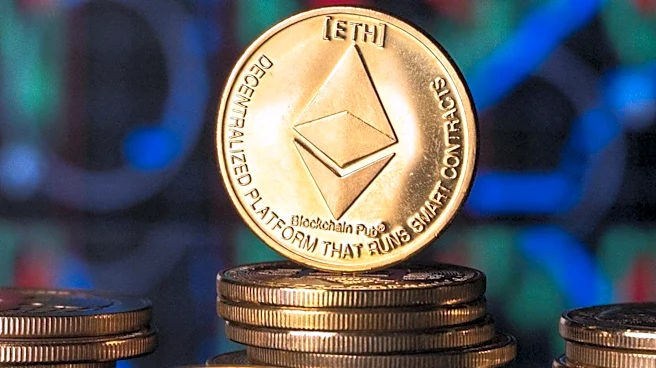
Fidelity's research analysts Max Wadington and Matt Hogan, examines various metrics including digital asset dominance, asset performance, and Net Unrealized Profit and Loss (NUPL). The analysts highlight that Bitcoin continues to be the most dominant digital asset, often serving as a benchmark for the sector. They also note a recent divergence in Bitcoin's correlation with the M2 money supply, suggesting a shift in capital flow, potentially towards AI-related stocks. For Ethereum, the report indicates an exit from the capitulation phase into a 'hope and fear' phase, with increased transaction counts but a significant portion being non-economically relevant. Solana shows consistent growth in transaction count with a stable ratio of economically relevant activity, suggesting organic growth despite its volatile history.
Why It's Important?
This report is crucial for U.S. investors and financial institutions as it offers a detailed, data-driven perspective on the evolving cryptocurrency market. The insights into digital asset dominance help investors understand market regimes (risk-on vs. risk-off) and how capital is allocated across different digital assets. The analysis of Bitcoin's valuation drivers, including its role as a monetary network and a scarce asset, provides a framework for understanding its long-term investment thesis amidst changing economic conditions. The discussion on the impact of institutional adoption and the competition for capital from sectors like AI highlights the increasing complexity of crypto market dynamics. For retail investors, the report emphasizes the importance of position sizing and long-term strategies to navigate the inherent volatility of digital assets, offering guidance on how to approach crypto investments without being 'boxed out' by larger players.
What's Next?
Fidelity Digital Assets will continue to publish its Signals Report quarterly, with the Q4 2026 report providing a sneak peek into forthcoming data. Investors can expect ongoing analysis of how market dynamics, such as the competition for capital and the maturation of the asset class, will influence cryptocurrency performance. The report suggests that the next Federal Reserve meeting on December 9, 2026, will be a significant event, as it will include projections for the economy and interest rates, potentially impacting crypto markets. The ongoing debate about whether the market is entering a new bull cycle will likely continue, with analysts using metrics like NUPL to gauge market sentiment and potential turning points. The transparency of Ethereum's development priorities, focusing on scalability over immediate monetization, indicates a continued emphasis on network growth, with potential future shifts towards value accrual.
Beyond the Headlines
The report subtly touches upon the broader implications of cryptocurrency's integration into the mainstream financial system. The increasing institutional adoption and the emergence of exchange-traded products (ETPs) for Bitcoin signify a shift from a niche, speculative asset class to one with growing legitimacy and accessibility. The discussion on the 'competition for capital' with AI-related stocks highlights a fundamental challenge for digital assets: how they will fare against other high-growth, innovative sectors in attracting investment. The distinction between economically relevant and spam transactions on networks like Ethereum raises questions about the true utility and sustainability of certain blockchain activities, prompting a deeper look into the underlying value proposition beyond mere transaction volume. This ongoing maturation demands a more sophisticated analytical approach, moving beyond simple price action to fundamental on-chain metrics to assess real adoption versus speculation.