


What's Happening?
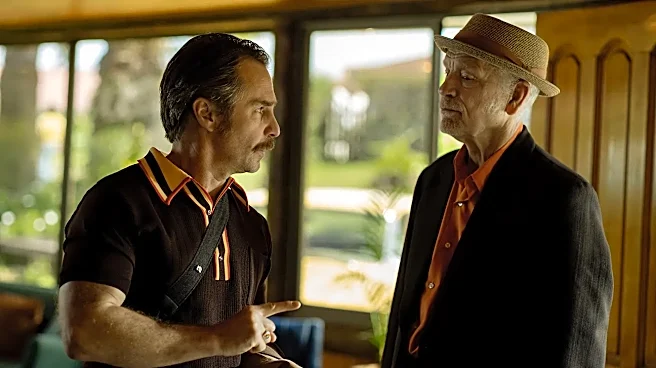
A review of Martin McDonagh's film 'Wild Horse Nine' emphasizes the director's distinctive approach to dialogue and storytelling, noting that the film is an 'acquired taste.' The movie features Sam Rockwell and John Malkovich as two CIA agents on Easter
Island, with a plot centered around one agent's impending death and a backdrop of future regime change. The review highlights that while some dialogue might appear 'clunky and weird' when read, the delivery by actors like Malkovich and Rockwell makes it effective and often humorous. McDonagh's script is characterized by meandering conversations that unexpectedly drop plot-relevant bombshells, requiring constant audience attention. The film avoids hyper-violence, instead focusing on character interactions and a slow, deliberate pace that builds tension and allows for natural comedic moments.
Why It's Important?
This review underscores the significance of directorial vision and actor performance in shaping a film's impact, particularly in independent cinema. McDonagh's willingness to defy audience expectations regarding pacing and plot development challenges conventional filmmaking norms, potentially influencing other creators to explore less formulaic narrative structures. The emphasis on dialogue delivery by seasoned actors like Malkovich and Rockwell highlights the critical role of performance in transforming written words into compelling cinematic experiences. For the industry, it demonstrates that films can succeed by prioritizing character depth and nuanced interactions over explicit action. For audiences, it offers a unique viewing experience that rewards patience and attention, potentially broadening their appreciation for diverse storytelling methods and the artistry of acting.
What's Next?
The critical reception of 'Wild Horse Nine' will likely contribute to ongoing discussions about Martin McDonagh's unique directorial style and his place among contemporary filmmakers. Positive reviews, particularly those highlighting the performances and dialogue, could enhance the film's visibility and attract a wider audience. This could also encourage more studios and independent producers to invest in projects that prioritize artistic vision and strong character development over mainstream appeal. For actors like Sam Rockwell and John Malkovich, their acclaimed performances in such a distinctive film could lead to further collaborations with directors known for their unconventional approaches. The film's subtle political commentary, even within its comedic framework, might also spark broader conversations about historical narratives and the role of cinema in social critique.
Beyond the Headlines
The review's observation that 'Wild Horse Nine' subtly reminds the U.S. of its 'historical record' regarding interventions in other countries, particularly South America, points to a deeper, less obvious implication of the film. By presenting characters who casually discuss installing military dictatorships, McDonagh uses dark humor to critique historical realities without being overtly preachy. This approach allows the film to engage with serious geopolitical themes in a way that is both entertaining and thought-provoking. It suggests that cinema can serve as a powerful, albeit indirect, medium for historical reflection and social commentary. The film's success in making audiences 'uncomfortable' with these casual discussions highlights the power of art to expose uncomfortable truths and challenge prevailing narratives, fostering a more critical engagement with history and current events.