




What's Happening?
Rivian Automotive experienced a significant surge in vehicle deliveries during the third quarter of 2026, with 19,248 vehicles delivered, marking a 58% increase from the previous quarter. This growth was largely driven by the R2 model becoming the company's
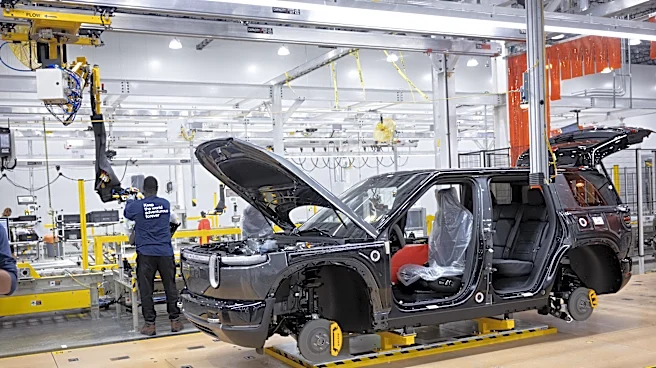
best-selling vehicle. Despite the substantial increase in deliveries, Rivian's companywide gross profit remained largely flat. This stagnation is attributed to a deteriorating automotive gross profit, which offset gains made in the software and services segment. The automotive gross loss widened from $36 million in Q2 to $80 million in Q3. Factors contributing to this include a decrease in regulatory-credit revenue and approximately $120 million in incremental R2 ramp costs, such as expedited freight and factory overhead spread across fewer vehicles than planned. Management noted that higher production can improve efficiency, but these launch expenses currently outweigh those gains.
Why It's Important?
The flat gross profit despite a significant increase in deliveries highlights the challenges electric vehicle manufacturers face in scaling production profitably. For Rivian, the R2 model's success in sales is a positive indicator of market demand, but the widening automotive gross loss suggests that the company is still struggling with manufacturing efficiency and cost control. This situation impacts investors who are looking for consistent progress towards profitability, especially as the company had been making strides in companywide gross profitability since 2023. The reliance on regulatory credits, which are now decreasing, further emphasizes the need for the automotive segment to become self-sustaining. The ability to translate increased sales into improved gross profit is crucial for Rivian's long-term financial health and its position in the competitive EV market.
What's Next?
Rivian's management anticipates that the vehicle business will achieve a gross profit by the end of 2026, though not for the fourth quarter as a whole. Investors will closely monitor Rivian's automotive gross profit for the fourth quarter of 2026, which is expected to be reported in February 2027. The company expects some of the R2 ramp costs to diminish as production scales and more shifts are added, leading to improved production efficiency. However, rising component costs are expected to continue impacting profitability. The focus will be on whether Rivian can effectively manage these costs and leverage its increased production volume to achieve sustained automotive gross profit, especially as regulatory credits and tariff-related benefits are expected to provide less support. The performance of the automotive segment, separate from the software and services segment, will be key to assessing the company's financial progress.
Beyond the Headlines
The situation at Rivian reflects a broader trend in the electric vehicle industry where rapid expansion and technological innovation often come with significant upfront costs and operational challenges. The company's decision to absorb higher parts costs rather than raise vehicle prices for its R2 model, which ranges from $45,000 to $57,000, indicates a strategic focus on market penetration and customer acquisition. This approach, while potentially beneficial for sales volume, puts immense pressure on manufacturing efficiency and supply chain management. The interplay between the growing software and services segment and the struggling automotive manufacturing highlights a potential shift in revenue streams for EV companies, where recurring software revenue could eventually subsidize vehicle production. This also raises questions about the long-term sustainability of EV startups that rely heavily on sales volume without immediate corresponding profit margins.