




What's Happening?
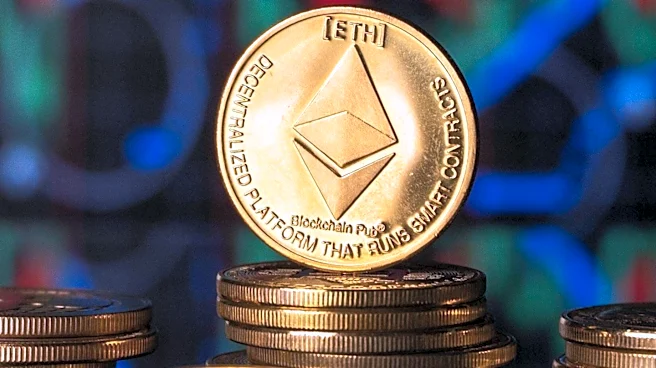
Tom Lee, Chairman of BitMine Immersion Technologies, stated on June 2, 2026, that Ethereum (CRYPTO: ETH) has the potential to reach $250,000. This long-term projection is attributed to increasing control from corporate validators, which are participants
who lock up their coins to secure the network. Despite this optimistic forecast, Ethereum's price has declined since Lee's statement. On June 2, it closed at $1,858, peaked at $2,775 on September 21, and then fell below $1,800 by November, currently trading around $1,690. BitMine's stock (NYSE: BMNR) has also mirrored this downturn, closing at $13.44 on November 25, marking a 50.5% decrease from the beginning of the year. As of November 23, BitMine holds 6.09 million Ethereum, valued at approximately $10.3 billion, which constitutes about 4.98% of the total supply.
Why It's Important?
Tom Lee's prediction, while ambitious, highlights the ongoing debate about the future valuation and underlying dynamics of major cryptocurrencies like Ethereum. His emphasis on corporate validators suggests a potential shift in the control and stability of the Ethereum network, which could influence its long-term growth and adoption. For investors, the significant discrepancy between Lee's target and Ethereum's current price, coupled with the recent market decline, underscores the volatile nature of cryptocurrency investments. The performance of BitMine's stock, directly linked to Ethereum's value, illustrates how corporate entities with substantial crypto holdings are exposed to these market fluctuations. This situation also brings attention to alternative investment avenues like the Grayscale Ethereum Staking Mini ETF for those seeking more traditional exposure to staked Ethereum, reflecting a growing diversification in crypto investment strategies.
What's Next?
The feasibility of Ethereum reaching Tom Lee's $250,000 target hinges on several factors. For Lee's thesis to gain traction, Ethereum must maintain its price above its June low close of $1,569, and the staking queue for validators needs to continue growing. Conversely, a drop below this critical price level could significantly impact BitMine's stock and make even a more modest goal of $10,000 by 2030 challenging. The long-term outlook for Ethereum will also depend on the continued growth of corporate staking, significant adoption of AI and tokenized assets on its network, and its ability to recover its all-time high. The market will closely watch these indicators to assess the potential for such a substantial price increase.
Beyond the Headlines
The discussion around Ethereum's potential valuation and the role of corporate validators touches upon broader implications for the decentralization ethos of cryptocurrencies. While increased corporate involvement might bring stability and institutional investment, it also raises questions about the concentration of power within the network. If a few large entities, like BitMine, accumulate significant portions of Ethereum, it could challenge the decentralized nature that is a core tenet of blockchain technology. This scenario could lead to debates about governance, network security, and the equitable distribution of control, potentially influencing regulatory approaches to cryptocurrencies. The long-term success of Ethereum, therefore, is not just about price appreciation but also about maintaining its foundational principles amidst evolving market structures.