




What's Happening?
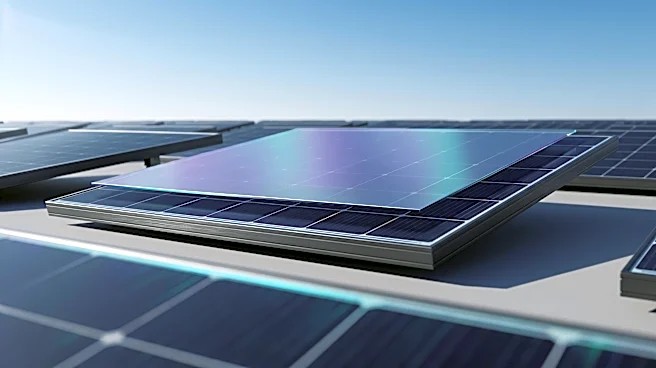
Qcells, a prominent solar manufacturer in the U.S., is advancing its plans to construct the world's first gigawatt-scale factory for next-generation tandem solar panels. These innovative panels combine traditional silicon cells with perovskite layers,
a crystal type that significantly boosts efficiency. While laboratory tests have shown remarkable efficiency records for these tandem constructions, their commercial viability has been challenged by durability issues in real-world conditions. Several startups, including Tandem PV, Oxford PV, and Caelux, have been working to overcome these challenges and commercialize perovskite panels, but none have yet achieved mass production with commercial warranties. Qcells, which has been developing tandem cells since 2016, is currently testing full-size tandem panels in the field and aims to open its gigawatt-scale production facility by 2029. The company previously launched a 40-megawatt pilot line in South Korea in 2024 to produce full-size tandem panels, following a pilot R&D line in Germany in 2022.
Why It's Important?
This initiative by Qcells marks a significant step in the global race to commercialize highly efficient solar technology. Current high-performance solar panels operate at approximately 24% efficiency, with incremental improvements of about half a percentage point annually. Qcells achieved a tandem efficiency record of 28.6% in 2024, which, if successfully scaled, could accelerate solar power adoption by effectively fast-forwarding years of conventional efficiency gains. The successful mass production of durable tandem perovskite panels could make solar energy even more competitive and accessible, potentially transforming the energy landscape. This development is crucial for the U.S. and global clean energy transition, as solar power is already a leading new power source. The entry of a major player like Qcells into this advanced manufacturing space intensifies competition and could drive further innovation, benefiting consumers and the environment through more efficient and cost-effective renewable energy solutions.
What's Next?
Qcells plans to open its gigawatt-scale factory for tandem solar panels in 2029, contingent on proving the long-term commercial viability of its products. The company will continue field-testing full-size tandem panels to ensure their durability and performance under real-world conditions. The success of Qcells' venture could prompt other major solar manufacturers to accelerate their own research and development in perovskite technology, intensifying competition in the advanced solar panel market. Startups in the field, such as Tandem PV, which aims for a gigawatt-scale factory by 2028, will be closely watching Qcells' progress. The broader implications include potential shifts in global solar manufacturing leadership and a significant boost to renewable energy targets worldwide. Future developments will likely focus on the long-term performance data of these panels and the economic feasibility of their mass production.
Beyond the Headlines
The pursuit of tandem perovskite solar technology by Qcells highlights a deeper trend in the renewable energy sector: the continuous push for higher efficiency and lower costs to accelerate the global energy transition. This development could reduce the land footprint required for solar farms, making solar power more feasible in densely populated areas or regions with limited available land. The ethical implications revolve around ensuring sustainable sourcing of materials for perovskites and managing the end-of-life cycle of these advanced panels. Legally, intellectual property rights for these new technologies will become increasingly important as competition heats up. Culturally, a significant increase in solar efficiency could further normalize and integrate solar power into daily life, influencing public perception and policy towards a more sustainable future. This technological leap could also foster greater energy independence for nations, reducing reliance on fossil fuels and their associated geopolitical complexities.