


What's Happening?
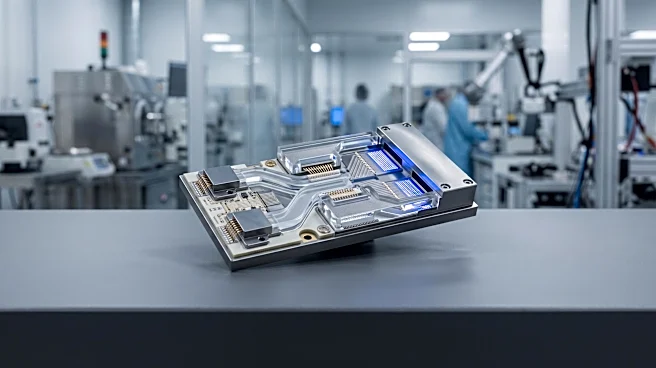
MaxLinear is significantly expanding its high-speed connectivity portfolio to meet the escalating bandwidth demands of AI data centers. The company is developing its next-generation Big Sky product family, which will feature 400G-per-lane PAM4 technologies
designed for 3.2T optical and electrical interconnects. This new platform aims to support the upcoming phase of data center network upgrades, moving beyond current 200G per lane speeds. The Big Sky family builds upon MaxLinear's existing Keystone and Rushmore platforms, which support 100G and 200G per lane PAM4 SerDes technologies, respectively. Keystone is already widely adopted in 800G optical deployments, while Rushmore is undergoing customer qualification for 1.6T architectures, with production expected in 2027. MaxLinear's strategy involves addressing multiple connectivity requirements within AI infrastructure, including optical and electrical interconnects, retimers, control plane connectivity, telemetry, and power management solutions. The company has also raised its 2026 optical data center revenue outlook to $250-$270 million, up from $210-$230 million, citing strong customer demand.
Why It's Important?
This expansion by MaxLinear is crucial for the continued growth and efficiency of AI data centers, which require increasingly faster and more robust interconnect solutions to handle massive data traffic. The development of 3.2T optical and electrical interconnects signifies a leap forward in data transfer capabilities, directly impacting the performance and scalability of AI workloads. As AI models become more complex and data-intensive, bottlenecks in data movement can severely limit computational efficiency. MaxLinear's comprehensive portfolio, spanning various layers of AI data center connectivity, positions it as a key enabler for next-generation AI infrastructure. The increased revenue outlook for its optical data center business underscores the strong market demand for these advanced solutions, indicating a significant investment trend in high-speed data center technology. This move also intensifies competition within the high-speed optical connectivity market, particularly with rivals like Marvell Technology, which is also rapidly advancing its 800G and 1.6T offerings.
What's Next?
MaxLinear's Big Sky product family represents a longer-term growth opportunity, with its contribution dependent on the pace of adoption of higher-speed data center networks and the progress of customer engagements. While customer qualification programs for the Rushmore platform (1.6T) are progressing with production deployments anticipated in 2027, the Big Sky platform (3.2T) will follow as data center networks transition to even higher speeds. The company will likely focus on securing key customer engagements and ensuring successful integration of its new technologies into hyperscale data centers. The competitive landscape, particularly with Marvell Technology's strong presence in optical DSPs and high-speed SerDes, suggests ongoing innovation and aggressive product development will be critical for MaxLinear to maintain and expand its market share. Future developments will also involve continued advancements in related areas such as co-packaged optics (CPO) and silicon photonics to further enhance energy efficiency and performance.
Beyond the Headlines
The relentless pursuit of higher bandwidth and lower latency in data center interconnects highlights a fundamental challenge in the AI era: the physical limitations of moving vast amounts of data. The transition to 3.2T interconnects and beyond is not merely an incremental upgrade but a necessary evolution to prevent data bottlenecks from stifling AI innovation. This technological race also has broader implications for energy consumption, as more efficient data movement can significantly reduce the power footprint of large-scale AI clusters. The emphasis on optical interconnects and silicon photonics reflects a shift towards more sustainable and scalable solutions. Furthermore, the intense competition among companies like MaxLinear and Marvell drives rapid advancements, pushing the boundaries of what's possible in high-performance computing and AI infrastructure. This continuous innovation is essential for supporting the ever-growing demands of AI, from large language models to complex scientific simulations, shaping the future of digital infrastructure.