




What's Happening?
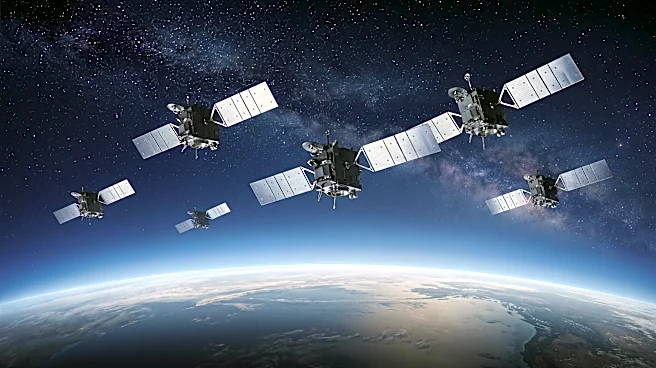
AST SpaceMobile, a U.S.-based telecommunications company, has formed a joint venture with Japanese technology conglomerate Rakuten Group, named Rakuten AST. This new entity is tasked with deploying a sovereign low Earth orbit (LEO) satellite communications constellation
across Japan. The venture is set to receive up to $1 billion in institutional funding over three years from the Japanese government under its J-LEO initiative. The goal is to provide cellular broadband directly to standard smartphones in Japan, offering 4G/5G speeds globally. AST SpaceMobile will manufacture and supply the large-aperture satellites, which will operate across commercial mid-band spectrum allocations to support high-throughput services like video streaming and voice calls without requiring modifications to consumer mobile handsets. Rakuten will hold 51% of the voting rights, with AST SpaceMobile's Japanese subsidiary holding 49%, ensuring the network is managed and operated within Japan using Japanese-flagged satellites.
Why It's Important?
This joint venture signifies a critical advancement in global satellite-to-device connectivity, particularly for the U.S. company AST SpaceMobile, by securing substantial international funding and a major partnership. For Japan, the initiative is crucial for disaster resilience, aiming to maintain communication services through ordinary smartphones even when terrestrial networks are damaged by frequent earthquakes and typhoons. This strategic move also allows Japan to diversify its satellite communication providers, reducing reliance on a single foreign entity like Starlink, which other Japanese carriers utilize. The integration of ground-based base station equipment into domestic Japanese infrastructure and the use of AI edge computing for spectrum management highlight a sophisticated approach to national communication security and autonomy. This model could influence how other countries approach critical national infrastructure, balancing foreign technology with domestic control.
What's Next?
Rakuten Mobile plans to initiate commercial-environment testing within 2026, with the aim of achieving full domestic operational service across Japan by the end of March 2029. The $1 billion funding from the Japanese government will be disbursed over three years through the Communications and Information Network Association of Japan (CIAJ). This project builds on existing programmatic ties between the U.S. and Japan, which previously designated AST SpaceMobile and Rakuten infrastructure under a bilateral technology accord. The successful deployment and operation of this network could serve as a blueprint for future international collaborations in satellite communications, especially for countries prioritizing disaster resilience and national control over critical infrastructure.
Beyond the Headlines
The Rakuten AST joint venture highlights a growing trend where national security and economic interests intersect with technological innovation in the space sector. Japan's emphasis on retaining majority ownership and domestic operational control, despite leveraging U.S. technology, underscores a broader geopolitical concern about data sovereignty and critical infrastructure. This model could set a precedent for how nations engage with foreign technology providers for essential services, particularly in areas prone to natural disasters or requiring robust, independent communication systems. The partnership also demonstrates the increasing validation of space-based cellular broadband as a vital complement to traditional terrestrial wireless infrastructure, potentially accelerating its adoption and development globally. The ethical implications of such widespread satellite connectivity, including privacy and data security, will likely become more prominent as these networks expand.