





What's Happening?
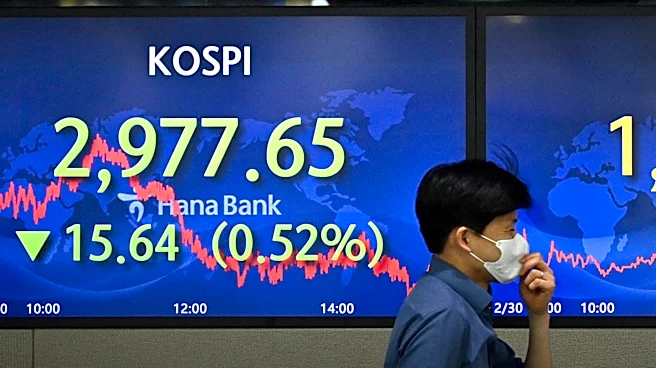
JPMorgan Chase & Co. has indicated that South Korea’s Kospi index appears undervalued following a significant market downturn, yet the bank has not identified a clear bottom for the market. The sell-off has driven valuations to near historic lows, but
foreign investors continue to withdraw capital, and domestic institutions have not provided sufficient support to stabilize prices. This situation presents South Korea as a potential value opportunity for investors, but one that carries considerable near-term timing risk. JPMorgan noted that market breadth was already weakening before the recent slide, with fewer stocks participating in gains. Additionally, share buybacks from major companies like Samsung Electronics and SK Hynix have concluded, removing a key source of support for the benchmark index. Foreign investors remain net sellers, while domestic pension funds and securities firms are making only limited purchases, contributing to fragile retail sentiment.
Why It's Important?
This assessment from JPMorgan Chase is crucial for U.S. investors and financial institutions with exposure to or interest in Asian markets. The Kospi's perceived cheapness, coupled with the lack of a clear market floor, highlights the complexities and risks involved in international equity investments. For U.S. fund managers and institutional investors, this situation demands careful consideration of entry points and risk management strategies. A prolonged period of instability in a significant Asian market like South Korea could have ripple effects on global investment portfolios, particularly those diversified across emerging markets. The caution from JPMorgan suggests that while valuations may be attractive, underlying market dynamics, such as investor sentiment and institutional support, are not yet conducive to a sustained recovery, impacting potential returns for U.S. capital seeking international growth.
What's Next?
JPMorgan Chase suggests that future catalysts for the Kospi will likely emerge from memory-chip earnings, results from hyperscalers, disclosures by AI model developers, and a potential decrease in market volatility, possibly coinciding with the end of the U.S. midterm election period. Despite the current challenges, the bank maintains a constructive view on Korea's fundamentals over the next six to twelve months, citing AI-related capital spending and potential improvements in corporate governance. However, JPMorgan has kept its Kospi target unchanged, indicating a cautious outlook until clearer signs of market stabilization appear. Investors will be closely watching these potential catalysts and broader economic indicators to determine the timing for a more confident re-entry into the South Korean market.
Beyond the Headlines
The situation in the Kospi index reflects broader global economic anxieties and the interconnectedness of international financial markets. The withdrawal of foreign capital and the insufficient domestic institutional support point to a lack of confidence that transcends mere valuation metrics, potentially signaling deeper concerns about global economic growth or specific regional vulnerabilities. For U.S. investors, this scenario underscores the importance of understanding not just company fundamentals but also macro-economic and geopolitical factors that influence market sentiment. The reliance on future developments in the AI sector and memory-chip earnings highlights the increasing influence of technology trends on national economies and stock markets. This situation could also prompt a re-evaluation of diversification strategies, emphasizing the need for robust analysis of market liquidity and investor behavior in addition to traditional valuation models.