





What's Happening?
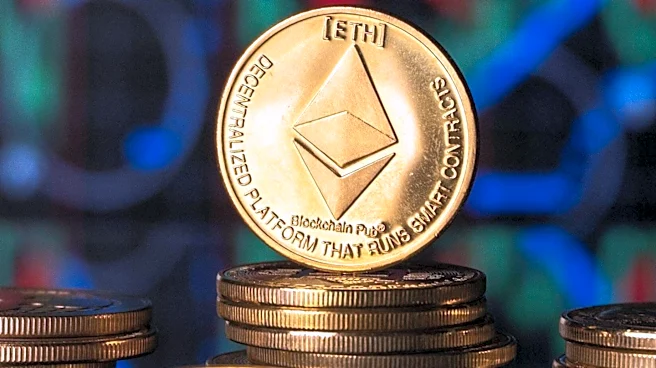
Ethereum's co-founder, Vitalik Buterin, has publicly called for developers to slow the rollout of a gas-pricing overhaul, dubbed 'Glamsterdam,' due to concerns that it could disrupt thousands of existing smart contracts. This comes as Ethereum's share
of the stablecoin market has fallen to a record low of approximately 46% of the total supply, according to Blockworks Data. Buterin stated in a November 28 post on X that developers' complaints about contracts breaking are valid and reasonable. He warned against a future where a centralized upgrade mechanism becomes standard security advice for Ethereum. While acknowledging the necessity of EIP-8037 and other significant changes, Buterin emphasized that the 'Glamsterdam' fork should not be rushed. He also suggested that the Ethereum Foundation and Ethlabs should provide more support to applications negatively impacted by the changes. Currently, about $125 billion of the $271 billion in stablecoins in circulation reside on Ethereum.
Why It's Important?
The proposed 'Glamsterdam' gas-pricing overhaul, specifically EIP-8037 and EIP-8038, aims to increase the cost of adding permanent data to Ethereum's state and reprice existing state reads and updates. This change is critical for node operators to manage rising block gas limits. However, many existing smart contracts were designed with fixed gas budgets for internal calls. If gas costs increase, these contracts could fail, even if their code remains unchanged. This poses a significant risk to a wide range of decentralized applications, including bridges, messaging systems, wallets, exchanges, governance tools, oracles, and staking protocols. The potential for widespread contract disruption could undermine user trust and operational stability within the Ethereum ecosystem. The decline in Ethereum's stablecoin market share, while not directly linked to the 'Glamsterdam' debate, adds to a challenging period for the platform, highlighting the competitive pressures from other blockchains like Tron, BNB Chain, and Solana.
What's Next?
The immediate next steps involve further deliberation and potential adjustments to the 'Glamsterdam' hard fork schedule, as urged by Vitalik Buterin. The Ethereum Foundation, Ethlabs, and other stakeholders will likely need to address the concerns raised by developers regarding contract compatibility. This could involve developing tools, guidelines, or support mechanisms to help applications migrate or adapt to the new gas pricing structure. Auditors like ChainSecurity have already identified numerous vulnerabilities related to fixed gas budgets, indicating a substantial workload for developers to ensure their contracts remain functional. The outcome of this debate will significantly influence the future development trajectory of Ethereum and its ability to maintain its position as a leading blockchain platform for decentralized applications and stablecoins. The community will be watching for announcements regarding the testnet and mainnet deployment dates for the 'Glamsterdam' upgrade.
Beyond the Headlines
The 'Glamsterdam' debate and Ethereum's declining stablecoin market share underscore a broader tension within the blockchain space: the balance between innovation and backward compatibility. While continuous upgrades are essential for scalability and efficiency, breaking changes can alienate existing users and developers, potentially driving them to alternative platforms. Buterin's caution highlights the ethical responsibility of core developers to consider the impact of protocol changes on the broader ecosystem. The discussion also touches upon the decentralization ethos of Ethereum; Buterin's warning against a 'centralized upgrade hatch' reflects a concern that frequent, disruptive changes could inadvertently lead to more centralized control or reliance on a few key entities for security advice. This ongoing challenge of evolving a decentralized network while preserving its integrity and user base will likely shape the future of blockchain development.