







What's Happening?
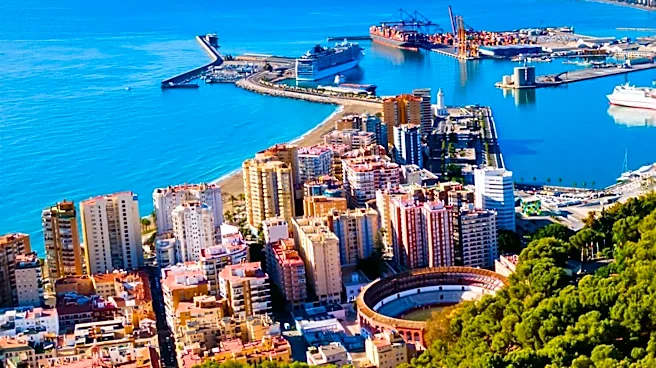
Antonio Banderas recently shared his thoughts on the evolving landscape of his hometown, Málaga, particularly concerning the rapid increase in tourism. He expressed a preference for the spontaneous, human interactions he still finds in Málaga, contrasting
it with his experiences living in Los Ángeles or New York. Banderas noted that while he recognizes the economic benefits of tourism, he also experiences its impact firsthand, citing instances where he has to navigate crowded streets due to cruise ship arrivals. He emphasized the need for Málaga to find a balance that allows both residents and visitors to coexist without losing the city's authentic character. Banderas described Málaga as an 'imperfect city,' a quality he cherishes, believing that its imperfections contribute to its charm and prevent it from becoming 'boring.' He highlighted the importance of preserving the city's 'human touch' amidst its transformation into a major tourist destination.
Why It's Important?
Banderas's observations underscore a critical challenge faced by many popular tourist destinations in the U.S. and globally: balancing economic growth from tourism with the preservation of local culture and quality of life for residents. His perspective, as a prominent figure deeply connected to Málaga, brings attention to the potential downsides of unchecked tourism, such as overcrowding and the erosion of local identity. This issue is particularly relevant for U.S. cities that rely heavily on tourism, as they grapple with finding sustainable models that benefit both visitors and long-term inhabitants. The discussion around Málaga's 'human touch' resonates with broader conversations about gentrification and the commodification of cultural heritage in tourist hotspots. Banderas's call for 'equilibrium' highlights the need for urban planning and tourism policies that prioritize community well-being alongside economic prosperity, ensuring that cities remain livable and authentic for their residents.
What's Next?
The ongoing dialogue initiated by figures like Banderas could prompt local authorities in Málaga and other tourist-heavy cities to re-evaluate their tourism strategies. This might involve implementing measures to manage visitor flow, such as regulating cruise ship arrivals or promoting tourism in less congested areas. There could also be increased focus on supporting local businesses and cultural initiatives to counteract the potential homogenization caused by mass tourism. Furthermore, Banderas's public statements might encourage greater community involvement in shaping tourism policies, fostering a more inclusive approach to urban development. The challenge will be to develop solutions that maintain the economic advantages of tourism while safeguarding the unique character and livability of these cities for their residents. This could lead to innovative urban planning solutions and community-led initiatives aimed at preserving local heritage and fostering sustainable tourism practices.
Beyond the Headlines
Beyond the immediate concerns of tourism management, Banderas's reflections touch upon deeper societal implications regarding identity and authenticity in an increasingly globalized world. His longing for spontaneous interactions and the 'imperfect' nature of Málaga speaks to a broader human desire for genuine connection and a sense of place. As cities become more uniform due to global trends and commercial pressures, the struggle to maintain unique local identities becomes more pronounced. This raises ethical questions about the responsibility of tourism industries and local governments to protect cultural heritage and foster community well-being. Banderas's comments serve as a reminder that the true value of a city lies not just in its attractions, but in its living culture and the everyday experiences of its people. The long-term shift could involve a redefinition of 'successful' tourism, moving beyond mere visitor numbers to include metrics of cultural preservation and resident satisfaction.