


What's Happening?
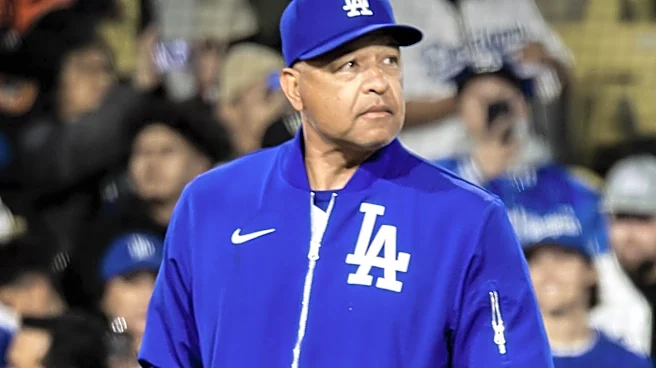
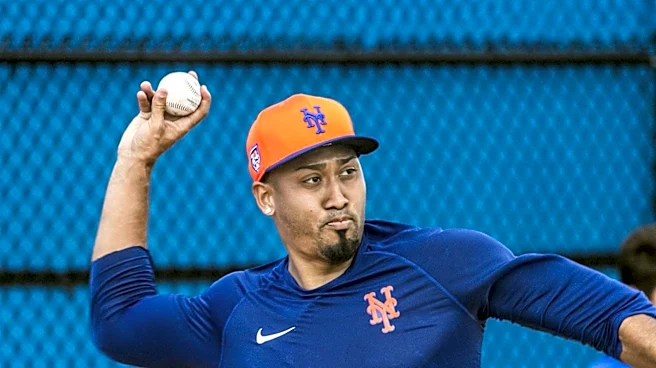
Edwin Díaz is set to rejoin the Los Angeles Dodgers on Friday after spending nearly five weeks on the 15-day injured list due to neck inflammation, following an earlier elbow surgery in April. Despite his return, Dodgers manager Dave Roberts confirmed
that Díaz will not immediately resume his role as the team's closer. Instead, he will be utilized in low-leverage situations, needing to prove his effectiveness to earn higher-leverage opportunities. Díaz's season has been plagued by injuries and poor performance, marked by an 11.85 ERA, a 2.56 WHIP, and four blown saves in 11 opportunities. His struggles continued during his rehab assignment with Triple-A Oklahoma City, where he walked seven batters and allowed six runs across five appearances, though his most recent outing was a scoreless inning. Roberts emphasized that Díaz must demonstrate quality strike-throwing and consistent performance to secure a spot on the playoff roster, indicating a merit-based approach to his role.
Why It's Important?
This development is significant for the Los Angeles Dodgers as they head into the postseason, impacting their bullpen strategy and the utilization of a high-profile, high-salary player. Díaz signed a three-year, $69 million contract, making him one of the highest-paid relievers in MLB history, yet his performance has been a major disappointment. His inability to consistently perform as closer has forced the team to rely on other relievers, such as Tanner Scott, who has stepped up in the role. The decision to place Díaz in low-leverage situations underscores the team's priority on performance and reliability, especially as they aim for a deep playoff run. For Díaz, this represents a critical period to regain form and trust, as his future role and potential inclusion on the postseason roster depend entirely on his ability to pitch effectively. The Dodgers' success in the playoffs could hinge on their bullpen's stability, making Díaz's return and performance a key factor.
What's Next?
Upon his return on Friday, Edwin Díaz will begin pitching in low-leverage situations for the Dodgers. The immediate focus will be on his ability to consistently throw strikes and get batters out, as highlighted by manager Dave Roberts. His performance in these initial appearances will be crucial in determining if he can gradually earn back higher-leverage opportunities and, ultimately, a spot on the postseason roster. The Dodgers will closely monitor his mechanics and delivery, which have been inconsistent throughout the season due to various physical ailments, including loose bodies in his elbow and neck inflammation. If Díaz demonstrates significant improvement and reliability in the coming games, he could potentially contribute to the Dodgers' bullpen in the playoffs. However, if his struggles persist, the team may opt to leave him off the postseason roster, a decision that would have considerable implications given his contract and initial expectations.
Beyond the Headlines
The situation with Edwin Díaz extends beyond immediate game-day decisions, touching upon the broader challenges of managing high-value contracts in professional sports, especially when performance falters due to injury. Díaz's substantial $69 million contract highlights the financial risk teams undertake with long-term deals for relief pitchers, whose performance can be volatile. His struggles this season, despite being a marquee free-agent acquisition, underscore the pressure on athletes to perform at an elite level, particularly after significant investments. The Dodgers' approach of requiring him to 'earn' his role back, rather than automatically reinstating him due to his contract, reflects a meritocratic philosophy that prioritizes team success over individual status. This scenario could influence future contract negotiations and team management strategies regarding injured or underperforming star players, emphasizing accountability and performance-based roles even for highly paid athletes. It also brings into focus the psychological aspect for a player like Díaz, who must overcome both physical setbacks and a crisis of confidence to reclaim his previous form.