




What's Happening?
Minisforum has launched two new products, the AI Agent NAS N5 MAX-P495 and the AI Mini Workstation MS-S1 MAX-P495, designed to bring advanced AI model processing to home and small office environments. These devices aim to reduce reliance on remote data
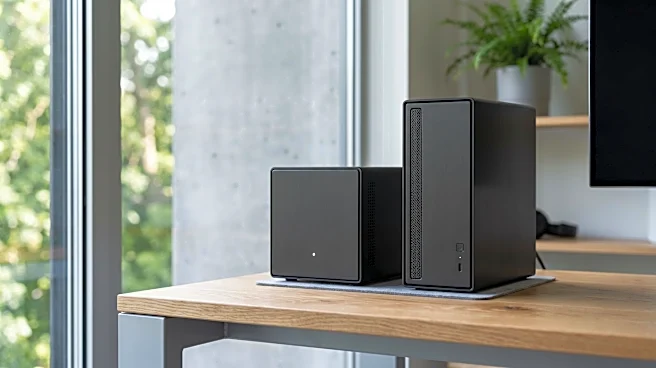
centers by providing robust local AI computing performance. The N5 MAX-P495 is a sleek black cube offering up to 200TB of local storage, capable of handling AI tasks natively and supporting various AI frameworks like RAG knowledge bases and AI agents. It functions as an efficient backend, merging storage and processing at the edge. Complementing this, the MS-S1 MAX-P495 is a compact tower built for intensive AI workloads, ideal for developers requiring substantial computing power for low-latency AI tasks such as security systems or generative AI tools. Together, these devices deliver up to 131 TOPS of AI computing performance, supported by 192GB of memory and up to 160GB of graphics memory, ensuring demanding tasks can be managed locally.
Why It's Important?
The introduction of Minisforum's AI powerhouse is significant for individuals and small businesses seeking greater control over their AI operations and data privacy. By enabling advanced AI models to run locally, these solutions reduce the need for cloud-based processing, which can be costly and raise concerns about data security. For small businesses, the ability to handle customer interactions and process sensitive data in-house, supported by frameworks like RAG knowledge bases, enhances data privacy and operational efficiency. Developers gain access to powerful, compact workstations for real-time AI applications, fostering innovation without the latency associated with cloud services. This shift towards localized AI computing could democratize access to advanced AI capabilities, making them more accessible and manageable for a broader range of users and organizations, thereby fostering a more distributed and secure AI ecosystem.
What's Next?
The availability of such powerful local AI solutions suggests a growing trend towards edge computing and decentralized AI processing. Consumers and small businesses are likely to explore these options to reduce operational costs associated with cloud services and enhance data sovereignty. Future developments may include further integration of these local AI capabilities with existing smart home ecosystems and business infrastructure, potentially leading to more sophisticated and personalized AI applications. As the demand for local AI grows, other manufacturers may follow suit, introducing competing products that offer similar or enhanced performance, driving innovation and making local AI solutions more commonplace. This could also spur the development of more user-friendly interfaces and broader software support for these local AI platforms.
Beyond the Headlines
The move towards powerful local AI solutions like those offered by Minisforum has broader implications beyond mere computational power. It signifies a potential shift in the power dynamics of AI, moving some control away from large cloud providers and towards individual users and smaller entities. This decentralization could foster greater innovation by allowing developers to experiment with AI models without the constraints or costs of cloud infrastructure. Ethically, it enhances data privacy by keeping sensitive information within the user's direct control, mitigating risks associated with third-party data handling. Legally, it could simplify compliance with data protection regulations by reducing cross-border data transfers. Culturally, it might lead to a more personalized and integrated AI experience, where AI tools are tailored to individual needs and operate seamlessly within personal or small business environments, fostering a new era of AI autonomy and creativity.