










What's Happening?
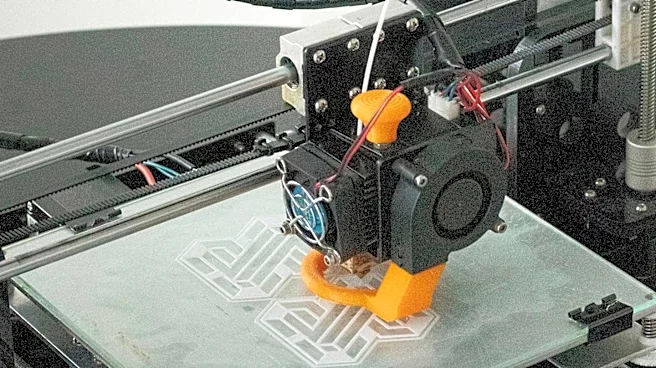
AMPERA, an advanced energy technology company, has achieved a significant milestone by unveiling the world's first full-scale, 3D-printed nuclear reactor module. This development was announced at the company's innovation center in Palm Beach Gardens,
Florida, where more than 100 guests, including local officials and business leaders, gathered to witness the event. The reactor module features a fully 3D-printed silicon carbide reactor core and pressure vessel, designed to operate for up to 30 years without refueling. AMPERA's nuclear systems are fueled with tri-structural isotropic (TRISO) thorium kernels, and the company has established an Australian subsidiary to secure thorium supply. The reactor is part of AMPERA's 'Power Now. Nuclear Next.' strategy, which aims to deliver ultra-high-efficiency power generation solutions through advanced manufacturing and next-generation energy technologies.
Why It's Important?
The unveiling of AMPERA's 3D-printed nuclear reactor module represents a significant advancement in nuclear energy technology. This innovation could revolutionize the energy sector by providing a scalable, factory-built solution that reduces reliance on traditional nuclear power systems. The reactor's design emphasizes safety and efficiency, potentially offering a more sustainable and reliable energy source for critical sectors such as data centers, defense, and industrial applications. By leveraging advanced manufacturing techniques, AMPERA aims to accelerate the deployment of nuclear power, which could have far-reaching implications for energy policy and the transition to cleaner energy sources. The company's focus on thorium as a fuel source also highlights a shift towards alternative nuclear fuels that promise enhanced safety and sustainability.
What's Next?
AMPERA plans to continue developing its modular nuclear systems, with larger configurations expected in the future. The company aims to be the first to industrialize factory-built nuclear power, with near-term deployment timelines. This could lead to increased interest and investment in advanced nuclear technologies, potentially influencing energy policies and market dynamics. Stakeholders in the energy sector, including policymakers and industry leaders, may closely monitor AMPERA's progress as they consider the implications of this technology for future energy infrastructure. Additionally, the company's strategy to integrate conventional-fueled power generation with nuclear systems could set a precedent for hybrid energy solutions that maximize efficiency and sustainability.