





What's Happening?
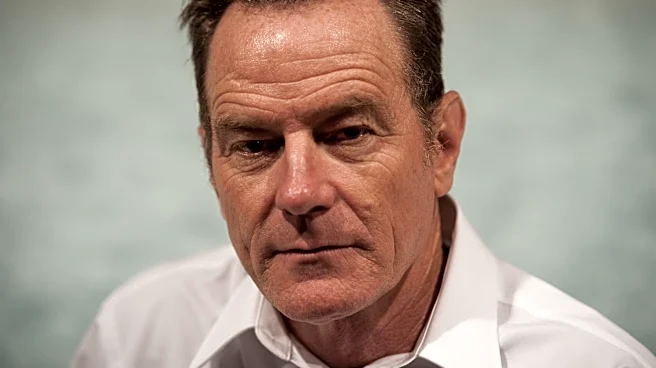
In 1998, actor Bryan Cranston undertook a significant role as Buzz Aldrin in the HBO miniseries 'From the Earth to the Moon,' a 12-part production by Ron Howard and Tom Hanks detailing the United States' Apollo space program. Cranston's preparation for
the role involved extensive research, which he admitted sometimes led to him falling asleep with notebooks and audiotapes related to lunar module landings. Despite the demanding research, Cranston recognized the importance of working on such a high-profile project and with esteemed collaborators. The miniseries itself was critically acclaimed, earning an Emmy for 'Outstanding Miniseries' and receiving 17 nominations, winning three awards.
Why It's Important?
This period in Bryan Cranston's career highlights the dedication and rigorous preparation often required for actors in major productions, particularly when portraying historical figures. His experience on 'From the Earth to the Moon' underscores the value of strong writing in television, as Cranston himself noted that well-written scripts provide essential nourishment for character development. The success of the miniseries, including its Emmy win, demonstrates the impact of high-quality storytelling and production in the entertainment industry. For Cranston, this role was a crucial step in his journey, preceding his global acclaim for 'Breaking Bad,' and showcased his commitment to his craft even in the face of challenging research demands.
What's Next?
While the event itself is historical, the insights from Bryan Cranston's experience continue to inform discussions about acting methodology and the importance of script quality in television and film production. The enduring legacy of 'From the Earth to the Moon' as an Emmy-winning miniseries reinforces the industry's appreciation for ambitious, well-executed historical dramas. For actors and creators, Cranston's reflections serve as a testament to the hard work involved in bringing complex characters and narratives to life, potentially influencing future approaches to biographical roles and large-scale productions.
Beyond the Headlines
Bryan Cranston's anecdote about falling asleep during research for his role as Buzz Aldrin offers a glimpse into the often unseen, arduous process behind acclaimed performances. It underscores the ethical responsibility actors feel when portraying real-life heroes, aiming for authenticity and respect. This commitment to thorough preparation, even when challenging, can elevate a performance from mere acting to a profound interpretation. The emphasis Cranston places on the quality of writing also highlights a broader cultural and artistic dimension: the symbiotic relationship between a compelling script and a powerful performance, where one feeds the other to create memorable and impactful storytelling.