






What's Happening?
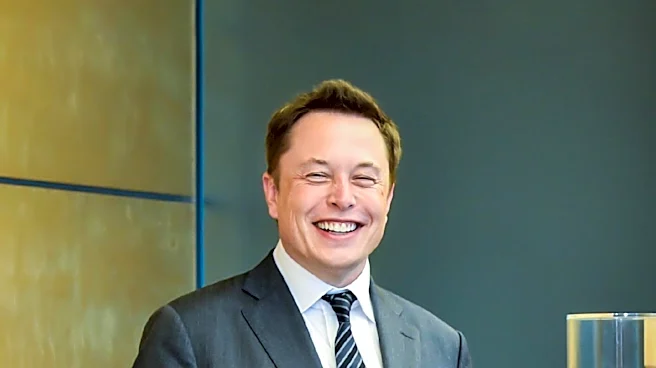
Elon Musk stated on November 6, 2026, that SpaceX could potentially acquire a legacy telecommunications carrier and utilize its airwaves 'ten times more effectively.' Speaking at the annual Baron Investment Conference in New York, Musk indicated that SpaceX could achieve
significant advancements with its existing spectrum holdings, though he did not name a specific acquisition target. He made any potential purchase conditional on SpaceX demonstrating superior spectrum utilization compared to the incumbent. This comment follows SpaceX's acquisition of AWS-4 and H-block licenses from EchoStar for approximately $17 billion in September 2025, and an agreement to buy nationwide 800 MHz licenses, expected to close in the first half of 2027. Deutsche Telekom CEO Tim Hoettges, whose company controls T-Mobile, estimated that competing with established U.S. carriers would require at least EUR 200 billion (approximately $220 billion) for SpaceX.
Why It's Important?
Elon Musk's suggestion of SpaceX acquiring a legacy U.S. telecommunications company has significant implications for the competitive landscape of the U.S. wireless market. Such a move could fundamentally alter the industry, introducing a powerful new player with advanced satellite technology and potentially disrupting the established dominance of current carriers like AT&T, Verizon, and T-Mobile. Enhanced spectrum utilization could lead to more efficient and widespread mobile services, particularly for direct-to-phone satellite connectivity, benefiting consumers in underserved areas. However, any acquisition would involve substantial debt, regulatory hurdles from antitrust authorities and the FCC, and the integration of complex legacy infrastructure. The market's reaction, with T-Mobile, Verizon, and AT&T experiencing slight dips, indicates the perceived threat and potential for disruption that SpaceX's entry could pose.
What's Next?
The immediate next step for SpaceX is the expected closing of its 800 MHz license acquisition in the first half of 2027. This will be a critical period to observe if any formal filings with the FCC or SEC indicate a move towards acquiring a U.S. carrier. If no such actions are taken, Musk's comment may remain hypothetical, potentially easing market concerns for existing carriers. Should SpaceX pursue an acquisition, it would face rigorous scrutiny from antitrust regulators and the FCC, given the significant consolidation it would represent in the telecommunications sector. The integration of a legacy carrier's debt, labor unions, retail stores, and landline networks would also present considerable operational challenges. The success of Starlink Mobile, SpaceX's direct-to-phone satellite service, is already factored into SpaceX's valuation, and its performance will be key to validating Musk's vision for enhanced spectrum use.
Beyond the Headlines
Musk's bold statement highlights a broader trend of technology giants challenging traditional industries through innovative approaches and significant capital. The idea of 'ten times more effective' spectrum utilization suggests a paradigm shift in how wireless services could be delivered, potentially leveraging satellite technology to bypass some limitations of terrestrial networks. This could lead to a re-evaluation of spectrum as a national resource and how it is allocated and managed. The potential entry of SpaceX as a fourth national wireless carrier also raises questions about market concentration, consumer choice, and the long-term impact on pricing and service quality. Furthermore, the regulatory challenges involved in such a large-scale acquisition would test the existing frameworks for telecommunications mergers and acquisitions, potentially setting new precedents for future industry consolidation and technological integration.