




What's Happening?
President Trump's administration has implemented 50% tariffs on approximately $28 billion worth of Canadian goods, effective Saturday at 12:01 a.m. ET. This action follows the failure of trade negotiations between the United States and Canada. U.S. Trade
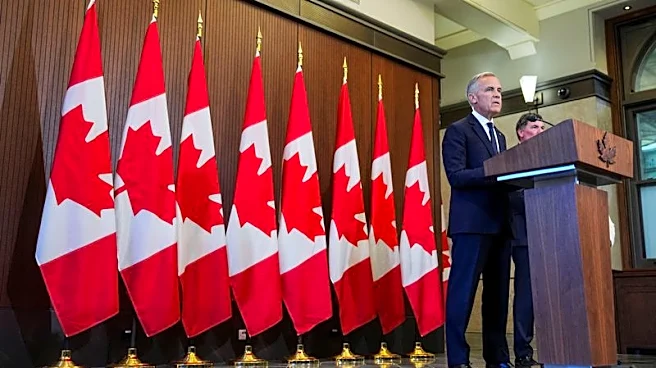
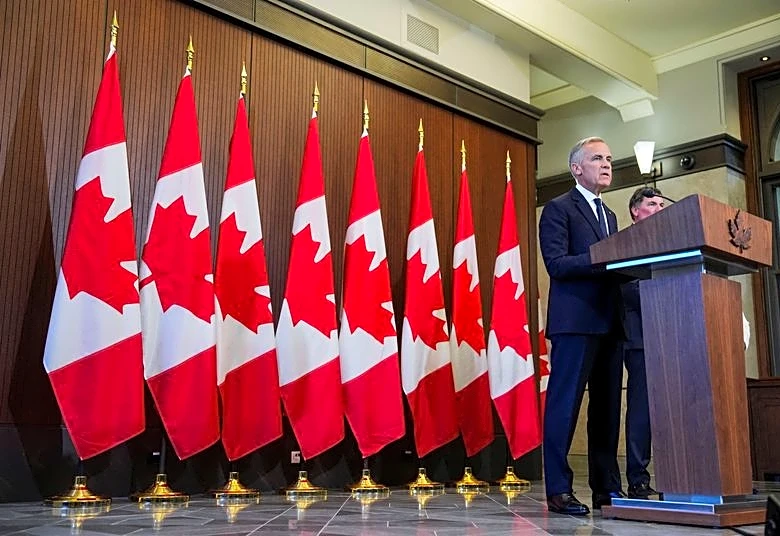
Representative Jamieson Greer stated that Canada declined to finalize a trade deal under previously agreed terms, citing new demands and reversals of commitments from Canada. The tariffs target a range of products, including hockey sticks, wine, dairy products, honey, and alcoholic beverages. Canadian Prime Minister Mark Carney announced Canada's suspension of trade talks, attributing the breakdown to 'last-minute changes' in U.S. proposed terms, which he deemed 'unfair' and 'uneconomic.' Carney indicated that Canada would impose retaliatory tariffs, matching the U.S. 'dollar for dollar,' with details to be released later and implementation set for September 8. The Canadian tariffs will focus on sectors such as steel, dairy, appliances, agricultural equipment, pulp and paper, and electronics.
Why It's Important?
The imposition of these tariffs and the subsequent retaliatory measures by Canada signify a significant escalation in trade tensions between two of the world's largest trading partners. For the U.S., these tariffs aim to address perceived trade imbalances and protect domestic industries, but they risk increasing costs for American consumers and businesses that rely on Canadian imports. Industries such as food and beverage, and potentially manufacturing, could see disruptions in supply chains and higher operational expenses. For Canada, the tariffs directly impact key export sectors, potentially leading to job losses and economic contraction. The retaliatory tariffs from Canada will similarly affect U.S. industries, particularly in agriculture, steel, and electronics, creating a cycle of economic friction. This trade dispute could also set a precedent for how the U.S. approaches trade relations with other allies, potentially leading to broader instability in global trade agreements and supply chains. The use of Section 338 of the Tariff Act of 1930, a provision never before invoked, highlights a novel and aggressive approach to trade policy, lacking judicial precedent and potentially inviting legal challenges.
What's Next?
The immediate next steps involve the implementation of Canada's retaliatory tariffs, which Prime Minister Carney stated would go into effect on September 8. Further details regarding the specific products targeted by Canada's tariffs are expected to be released. The breakdown of talks suggests a prolonged period of trade disputes between the two nations, with potential for further escalations. Businesses in both the U.S. and Canada will need to adjust their supply chains and pricing strategies to account for the new tariffs. Political leaders will likely face pressure from affected industries and consumers to resolve the dispute. The lack of judicial precedent for the use of Section 338 of the Tariff Act of 1930 could lead to legal challenges, potentially shaping future trade policy. The broader implications for the United States-Mexico-Canada Agreement (USMCA) are also uncertain, as these tariffs apply to products otherwise compliant with the agreement, raising questions about the stability of existing trade frameworks.
Beyond the Headlines
This trade dispute extends beyond immediate economic impacts, touching upon deeper issues of national sovereignty and economic integration. Prime Minister Carney's assertion that Canada was 'not prepared to compromise Canada's sovereignty or undermine our key industries' underscores the political and nationalistic dimensions of trade policy. The Trump administration's use of economic tools as a 'weapon,' as described by Carney, could fundamentally alter the nature of international trade relationships, moving away from multilateral cooperation towards more unilateral and protectionist approaches. This shift could lead to a fragmentation of global supply chains and a re-evaluation of economic alliances. The dispute also highlights the vulnerability of industries that have become deeply integrated across borders, demonstrating how political decisions can rapidly disrupt established economic flows. The long-term consequence could be a more volatile and less predictable global trading environment, where economic policy is increasingly intertwined with national security and political leverage.