






What's Happening?
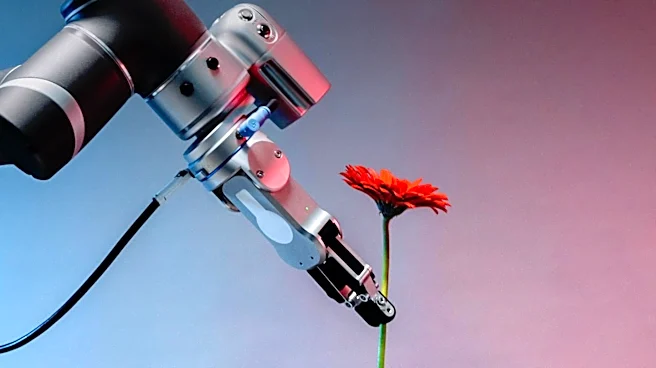
Anthropic, an AI company, has established a physical biology laboratory in the San Francisco Bay Area to test whether its AI model, Claude, can direct robotic lab equipment through scientific experiments with limited human involvement. This initiative
marks Anthropic's first confirmed venture from software-only AI into hands-on wet-lab science, as confirmed by Eric Kauderer-Abrams, Anthropic's head of life sciences. While the company has not disclosed the lab's exact location, size, cost, or specific experiments, it has clarified that the facility is not exclusively for drug discovery and is not conducting clinical trials. The project aims to explore the potential of general-purpose language models to plan and direct hardware through scientific protocols, moving beyond computational predictions to real-world execution. This development positions Anthropic differently from competitors like OpenAI and Google DeepMind, which have primarily focused on general reasoning and scientific claims through their models without dedicated wet-lab infrastructure.
Why It's Important?
This move by Anthropic signifies a critical shift in the application of AI, extending its capabilities from virtual environments to physical scientific experimentation. By enabling Claude to direct lab robots, Anthropic aims to accelerate biological research processes, potentially leading to significant advancements in various life sciences fields. The ability of an AI to interpret sensor readings, sequence pipetting steps, and flag anomalies in a physical lab could dramatically increase the efficiency and scale of experiments. This in-house capability allows Anthropic's models to learn from direct lab feedback, similar to how they learn from code execution feedback in software, which could lead to more robust and reliable AI-driven scientific discovery. This development also highlights the growing intersection of frontier AI research and wet-lab biology expertise, creating a competitive landscape for talent and potentially influencing hiring budgets across the biotech sector.
What's Next?
Anthropic is expected to provide more detailed information about the lab, including specific experiment types, once results are sufficiently robust. This move will likely intensify competitive pressure on other major AI players like OpenAI and Google DeepMind to clarify or expand their own physical science infrastructure plans. Biosecurity researchers and policy groups are also anticipated to raise questions regarding the oversight structures for the AI-directed lab, given Anthropic's public commitment to AI safety. While Anthropic maintains that human involvement remains crucial for safety, the long-term goal is to reduce human intervention. Pharmaceutical companies may explore partnerships with Anthropic, anticipating the potential for AI-driven lab automation to streamline drug discovery and development processes. The company's history of turning internal capabilities into external products suggests that a commercial lab automation service could eventually emerge, though it is currently in its early stages.
Beyond the Headlines
Anthropic's foray into physical biology labs with AI-directed robotics raises deeper implications concerning the future of scientific research and biosecurity. The integration of advanced AI with physical experimentation could lead to unprecedented rates of discovery, but it also introduces new ethical and safety challenges. The potential for a sufficiently capable, poorly supervised AI system to inadvertently synthesize dangerous biological agents is a significant concern, underscoring the need for robust guardrails and human oversight. This development also challenges the traditional role of human scientists, as AI systems take on more autonomous functions in the lab. The long-term shift could involve a redefinition of scientific methodology, with AI becoming an indispensable partner in experimental design and execution. The ethical governance of such powerful AI systems in sensitive scientific domains will be a critical area of focus for policymakers and the scientific community.