
What's Happening?
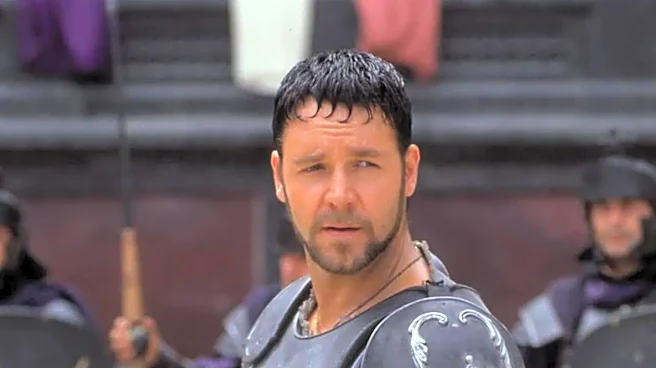
Actor Russell Crowe initially held significant doubts about the potential success of the film 'Gladiator,' despite it later winning him an Academy Award for Best Actor and securing five Oscars overall.
According to AlloCiné, Crowe described the script as 'absolute rubbish' and expressed strong reservations during production. The film faced numerous challenges, including a period when historical epics were out of favor in Hollywood and director Ridley Scott had not achieved a major success since 'Thelma & Louise' in 1991. Crowe's dissatisfaction was so profound that, at the start of filming, only 21 pages of the script were agreed upon by him and Scott, necessitating extensive rewrites by multiple screenwriters, including John Logan and William Nicholson. Crowe even found one of Maximus's most iconic lines, 'I will have my vengeance, in this life or the next,' to be excessive and unbelievable at first.
Why It's Important?
This revelation highlights the often unpredictable nature of filmmaking and how creative disagreements and initial skepticism can precede monumental success. For the U.S. film industry, 'Gladiator' became a benchmark for historical epics, demonstrating that even projects fraught with internal conflict and a perceived lack of initial quality can achieve critical and commercial triumph. It underscores the collaborative, yet sometimes contentious, process of movie production, where the vision of a director and the performance of an actor can elevate a troubled script into a masterpiece. The film's eventual acclaim also revitalized the historical epic genre, influencing subsequent productions and proving that audience appetite for such stories could be rekindled with compelling storytelling and strong performances.
What's Next?
While 'Gladiator' is a past success, its production story continues to offer insights into the creative process. The film remains available for streaming on platforms like Prime Video, allowing new audiences to discover it and existing fans to revisit it with this behind-the-scenes context. The enduring popularity of 'Gladiator' and its complex production history may continue to be a subject of discussion in film studies and industry retrospectives, particularly as sequels or related projects are occasionally rumored. The narrative of a film overcoming significant internal hurdles to achieve greatness serves as a case study for aspiring filmmakers and industry professionals on the resilience and transformative power of collaborative art.
Beyond the Headlines
The 'Gladiator' production story delves into the deeper implications of creative friction and artistic compromise in Hollywood. It illustrates that even seasoned professionals like Russell Crowe can misjudge the potential of a project, and that a director's conviction, like Ridley Scott's, can be crucial in steering a film toward success despite significant resistance. The constant script rewrites during filming also raise questions about the pressures of production schedules and the iterative nature of storytelling in cinema. This case highlights the delicate balance between historical accuracy and audience appeal, as seen in Crowe's objection to historically accurate but potentially anachronistic elements like sponsors on gladiators' armor. Ultimately, it showcases how a chaotic production environment can, against all odds, foster a work of enduring cultural significance.