





What's Happening?
Freiburg-based startup EDENenergy is transforming discarded e-bike and e-scooter batteries into industrial energy storage systems in Germany. Annually, approximately one million high-performance batteries from micromobility devices are prematurely disposed
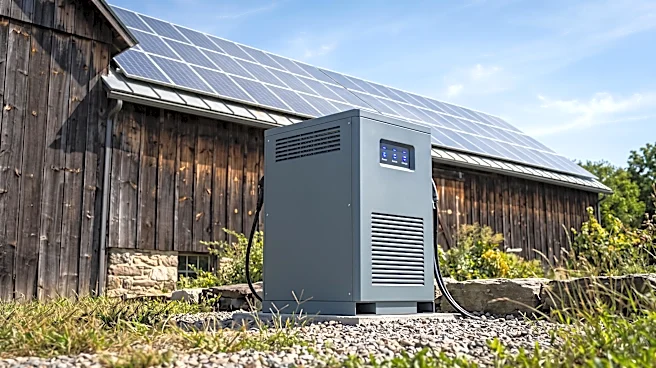
of, despite retaining significant capacity. EDENenergy, founded by former researchers from the Fraunhofer Institute for Solar Energy Systems ISE, has developed modular systems that integrate these second-life batteries. The company's technology utilizes flexible power electronics to combine diverse battery modules into stationary storage systems safely and efficiently, without requiring battery dismantling. EDENenergy recently delivered its first industrial storage system, a 70 kilowatt-hour (kWh) unit integrating 112 second-life e-scooter batteries, to a customer in mid-October 2026. Initial assessments of 350 tested batteries revealed that their remaining capacity often exceeded 90%, significantly higher than the anticipated 80%. These batteries are well-suited for stationary applications due to reduced mechanical stress and temperature fluctuations compared to their original use, potentially extending their service life by several years.
Why It's Important?
This initiative by EDENenergy addresses a significant waste problem and promotes resource efficiency within the energy sector. By repurposing batteries that would otherwise be discarded, the company contributes to a circular economy, reducing the demand for new battery production and minimizing electronic waste. The high retained capacity of these second-life batteries makes them a viable and cost-effective solution for industrial energy storage, particularly for medium-sized businesses with existing photovoltaic installations. This approach offers a sustainable alternative to conventional energy storage systems, which typically guarantee only 80% of original capacity after ten years. The technology's ability to integrate diverse battery designs overcomes a major obstacle in battery reuse, potentially unlocking a vast untapped resource for energy storage and supporting the broader transition to renewable energy sources.
What's Next?
Following the successful delivery of its first industrial installation, EDENenergy plans to expand its storage capacity to systems up to 300 kWh. The startup is actively seeking additional pilot customers among regional businesses, with potential customers eligible for funding covering 50% of the storage system's cost through the Baden-Württemberg state program 'Mittelstand trifft Start-ups.' In the long term, EDENenergy identifies two critical conditions for scaling up second-life battery storage: the establishment of standardized communication protocols for battery storage systems and the implementation of legislation that provides clear guidelines for using mobile-designed batteries in stationary energy storage applications. The company's modular approach allows for individual battery module replacement as they degrade, aiming to maintain the system's nominal capacity over extended periods.
Beyond the Headlines
The development by EDENenergy highlights a growing trend in sustainable technology and resource management, particularly in the context of the rapidly expanding electric vehicle and micromobility markets. The concept of giving batteries a 'second life' before recycling them represents a crucial step towards maximizing the utility of finite resources and reducing the environmental footprint of battery production and disposal. This model could inspire similar initiatives globally, fostering innovation in battery management and energy storage solutions. Furthermore, the success of such ventures could influence policy-making, encouraging governments to develop frameworks that support battery reuse and recycling, thereby creating new economic opportunities and contributing to energy independence and grid stability. The focus on modularity also offers a more resilient and adaptable energy storage solution, as individual components can be maintained or replaced without decommissioning the entire system.