


What's Happening?
Oklo Inc., a nuclear energy company, is actively pursuing opportunities to generate revenue from its nuclear fuel business by supplying other companies, potentially before its first commercial nuclear power plant becomes operational in 2028 or 2029. The
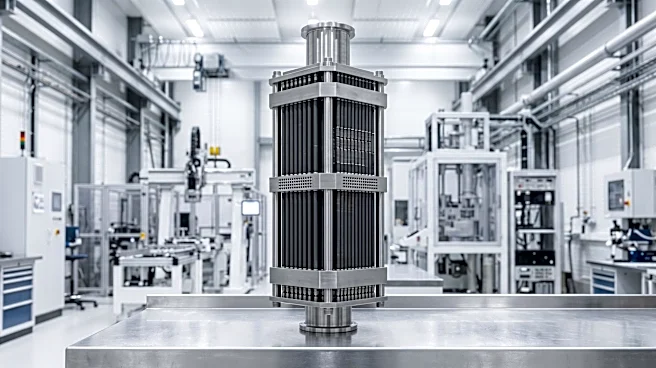
company is installing equipment at its Aurora Fuel Fabrication Facility at the Idaho National Laboratory, with plans to produce its first complete fuel assembly in 2027. While the immediate focus is on supplying fuel for its own reactors, Oklo is also exploring serving third-party customers. This strategy is driven by the limited domestic supply of high-assay low-enriched uranium (HALEU), a specialized fuel required by many advanced nuclear reactors. Oklo has already recognized approximately $3.1 million in revenue in the first nine months of 2026, primarily from two acquired engineering companies, but recorded an operating loss of about $195.2 million during the same period. The company maintains a strong financial position with $3.13 billion in cash, cash equivalents, and marketable debt securities as of the third quarter.
Why It's Important?
This strategic shift by Oklo to become a nuclear fuel supplier could significantly impact the nascent advanced nuclear reactor market in the U.S. The limited domestic production capacity for HALEU presents a bottleneck for the development and deployment of new nuclear technologies. By stepping in as a fuel provider, Oklo could alleviate supply chain concerns for other advanced reactor developers, fostering broader growth in the sector. This move also allows Oklo to diversify its revenue streams and potentially achieve profitability sooner, reducing its reliance solely on electricity sales from its own power plants. For the U.S. energy landscape, increased domestic nuclear fuel production enhances energy independence and supports the transition to cleaner energy sources. Companies developing advanced reactors stand to gain from a more secure and accessible fuel supply, while Oklo positions itself as a critical enabler for the industry's expansion.
What's Next?
Oklo anticipates that some fuel-related services could begin generating revenue within the next two years, with more substantial revenue contingent on the expansion of its manufacturing capabilities. The company's Aurora Fuel Fabrication Facility is expected to produce its first complete fuel assembly in 2027. Oklo has already signed a nonbinding memorandum of understanding with Standard Nuclear to explore potential purchases of recycled nuclear fuel materials, indicating commercial interest. Additionally, Oklo was awarded approximately $6.8 million by the U.S. Department of Energy to advance its recycled nuclear fuel technology. Future developments will include securing binding fuel supply contracts and disclosing details on production capacity, pricing, and manufacturing costs, which will be crucial for assessing the long-term value of this business segment.
Beyond the Headlines
Oklo's foray into third-party nuclear fuel supply highlights a critical challenge and opportunity within the U.S. nuclear energy sector: the need for a robust domestic fuel cycle. Historically, the U.S. has relied on foreign sources for certain nuclear fuel components. Oklo's efforts to produce HALEU and recycle nuclear fuel could contribute to national energy security and reduce geopolitical dependencies. This initiative also underscores the broader economic implications of advanced nuclear technology, moving beyond just power generation to encompass specialized manufacturing and supply chain development. The success of Oklo's fuel business could set a precedent for other companies to invest in the nuclear fuel cycle, fostering a more integrated and resilient domestic nuclear industry. This could also lead to a re-evaluation of regulatory frameworks to support the accelerated development and commercialization of advanced nuclear fuels.