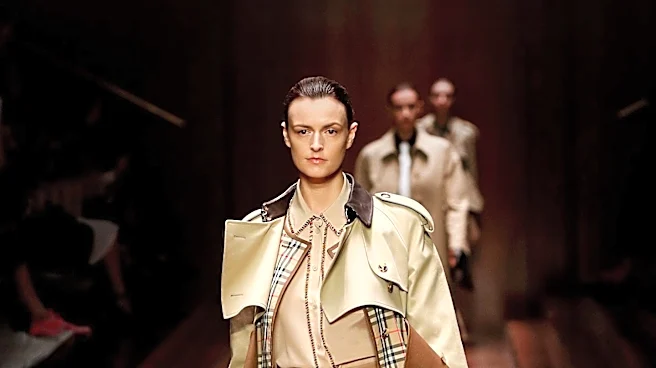

What's Happening?
Burberry has announced a 6% increase in its first-half revenue, reaching 1.1 billion pounds, alongside a profit of 54 million pounds, a significant improvement from an 18 million pound loss in the previous
year. This performance bucks the trend in a challenging luxury market, with adjusted operating profit more than tripling to 62 million pounds. The company attributes this success to efforts in sharpening its supply chain, controlling costs, and achieving 'better quality' sales where full-price transactions surpassed outlet sales. Comparable retail sales saw a 4% rise in the first half and the second quarter, marking the fifth consecutive quarter of growth. All major product categories experienced growth, and wholesale revenue increased by 17%, exceeding guidance. The Americas region was a significant growth driver, with sales up 12% due to local customers and strong engagement programs. China also saw a 7% increase in sales during the first half, driven by local spending and intraregional tourism, reflecting strong brand positioning and localization efforts.
Why It's Important?
Burberry's strong financial performance is significant as it demonstrates resilience and strategic effectiveness in a luxury market facing headwinds. While many luxury brands are experiencing slowdowns, Burberry's ability to achieve substantial revenue and profit growth highlights the success of its 'Burberry Forward' turnaround strategy. This outperformance, particularly in the U.S. and Chinese markets, indicates that the brand's focus on a 'democratic pricing strategy,' broad customer base, and authority in outerwear is resonating with consumers. The growth in the Americas, driven by local customers and 'very important customer' engagement, suggests a successful localized approach. Furthermore, the increased wholesale revenue, particularly in the U.S. through key retailers like Bloomingdale's and Nordstrom, underscores the brand's expanding market penetration and distribution strength. This success could serve as a case study for other luxury brands navigating a cautious consumer environment and seeking to balance prestige with broader accessibility.
What's Next?
Burberry anticipates continued growth in wholesale, projecting an increase of 10% to 12% for the full year, primarily driven by key U.S. retailers. The brand plans significant investments, including upgrades to its Yorkshire factories, which produce its iconic trench coats, and a major transformation of its Regent Street flagship store in London. The Regent Street location will be reimagined as 'Burberry House,' aiming to offer immersive experiences that blend the brand's heritage, culture, and collections, moving beyond traditional retail. This initiative will also introduce Burberry's new global store design language, the 'Regent Concept.' The company is also focusing on expanding its ready-to-wear and leather accessories categories, with plans for pop-ups and in-store destinations for various product lines. Collaborations, such as the recent successful tie-up with Palace, are expected to continue enhancing its ready-to-wear offerings. These strategic moves indicate a clear path toward sustained growth and an enhanced brand experience.
Beyond the Headlines
Burberry's strategy of positioning itself in a 'sweet spot' between mass-market brands like Ralph Lauren and ultra-luxury brands like Hermès reveals a deeper understanding of evolving consumer behavior in the luxury sector. By offering a range of products, from accessible items to $15,000 handbags, Burberry aims to capture a wider demographic, including aspirational consumers who might be priced out of higher-end luxury. The emphasis on outerwear as a 'halo effect' for other product categories demonstrates a strategic leveraging of its core strength to drive sales across its portfolio. The brand's efforts in China, including localized campaigns and celebrity ambassadors, highlight the importance of cultural relevance and regional adaptation in global luxury markets. The planned transformation of its Regent Street store into 'Burberry House' signifies a shift towards experiential retail, recognizing that modern consumers seek more than just products; they desire immersive brand experiences and a sense of community. This approach could redefine the role of flagship stores in the luxury landscape.