






What's Happening?
The Aurora City Council has unanimously voted 10-0 to prohibit large-scale evaporative cooling systems in future data center designs. This decision aims to balance economic growth with water stewardship in Aurora, a city located on an arid high plain
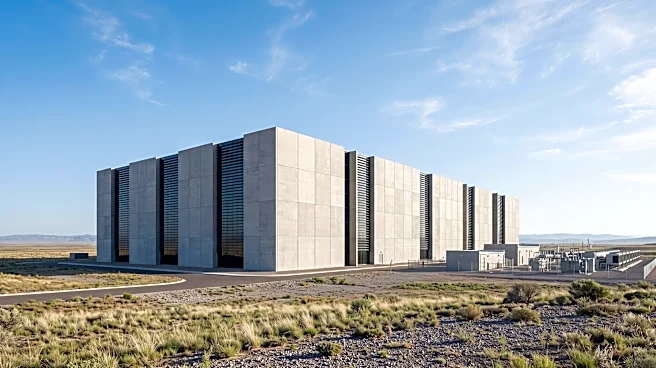
with limited natural water sources. The ban applies to unapproved future projects and is not retroactive, meaning existing data centers and those already in the permitting process with approved designs are not affected. The QTS data center project, which utilizes a closed-loop cooling system recycling internal liquid and consuming less than 1 million gallons of water annually, served as an inspiration for the council's decision. Projects like Vantage's Trident Data Center, currently in the planning and permitting pipeline, will be subject to the new law, potentially requiring alterations to their engineering timelines. Aurora obtains 95% of its water from surface sources, requiring the purchase of water rights from distant basins.
Why It's Important?
This ban signifies a critical step by Aurora to address water scarcity concerns, setting a precedent for other water-stressed cities grappling with similar issues. Data centers are known for their significant water consumption, particularly those using evaporative cooling, making this a pivotal policy for environmental sustainability. While promoting water conservation, the ban may also influence the operational costs and design choices for technology companies looking to establish or expand data centers in Aurora. Companies might need to invest in more expensive, less water-intensive cooling technologies, potentially leading to higher electrical energy usage due to increased reliance on fans, pumps, and mechanical compressors. This decision reflects a growing awareness among local governments about the environmental footprint of technological infrastructure and the need for sustainable development practices.
What's Next?
Data center developers planning new facilities in Aurora will need to adapt their designs to comply with the new evaporative cooling ban, likely incorporating closed-loop or other water-efficient cooling technologies. This could lead to increased research and development in sustainable cooling solutions within the data center industry. Aurora city officials may continue to assess other regulatory issues related to data centers, such as setbacks and landscape buffers, indicating a broader effort to manage the industry's impact. Other water-stressed municipalities might look to Aurora's approach as a model for balancing economic development with environmental conservation, potentially leading to similar regulations across the U.S. The long-term impact on Aurora's attractiveness as a data center hub will depend on how effectively companies can innovate within these new constraints.
Beyond the Headlines
The Aurora City Council's decision highlights a growing tension between rapid technological expansion and environmental sustainability, particularly in regions facing resource constraints. This move could accelerate the adoption of more sustainable data center technologies, pushing the industry towards greater energy efficiency and reduced water dependency. It also underscores the increasing role of local governance in shaping the environmental practices of major industries. While the ban addresses water consumption, it may inadvertently shift the environmental burden to increased electricity usage, prompting a need for holistic sustainability assessments. This policy could spark broader conversations about the true environmental cost of the digital economy and the responsibility of tech companies to operate sustainably, especially in vulnerable ecosystems. It also emphasizes the complex interplay between economic development, technological advancement, and ecological preservation.