
What's Happening?
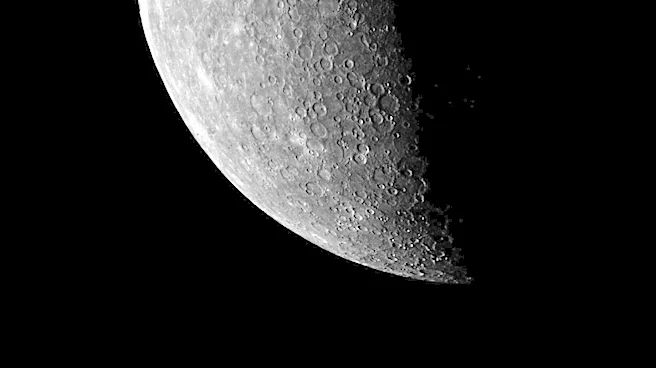
On July 23, 2026, Mercury, the smallest planet in the solar system, concluded its retrograde motion and began moving eastward. This astronomical event marks a shift in Mercury's path as it transitions
from moving westward to eastward in the sky. Located in the constellation Gemini, Mercury is visible shortly before sunrise, although it is faint and best observed with binoculars or a telescope. This change in motion is part of Mercury's regular orbital cycle and provides an opportunity for skywatchers to observe the planet's behavior.
Why It's Important?
Mercury's transition from retrograde to prograde motion is a significant event for astronomers and astrology enthusiasts. For astronomers, it offers a chance to study the planet's orbit and its interactions with other celestial bodies. Understanding Mercury's motion can provide insights into the dynamics of the solar system and the gravitational influences affecting planetary orbits. For astrology enthusiasts, Mercury's retrograde is often associated with communication and technology disruptions, and its end is seen as a time for resolution and forward movement. This event highlights the intersection of science and cultural beliefs in celestial phenomena.
What's Next?
As Mercury continues its eastward journey, astronomers will monitor its path and interactions with other planets. This includes observing its position relative to the Sun and other celestial bodies. The planet will eventually cross into the constellation Cancer, offering further opportunities for observation. For the public, this event may inspire interest in planetary motion and encourage educational activities related to astronomy. Future retrograde cycles of Mercury will continue to be of interest to both scientists and the general public, providing ongoing opportunities for study and engagement.