





What's Happening?
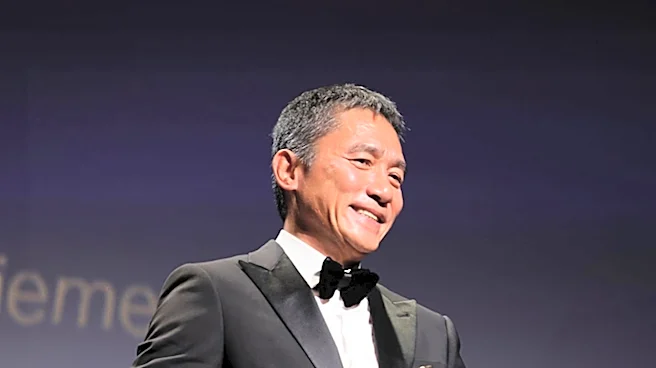
A review of the 1991 Hong Kong film 'Fantasy Romance' highlights Tony Leung Chiu-wai's early career, noting that the supernatural comedy is considered a 'waste of time and talent' despite his later acclaimed performances. In 'Fantasy Romance,' Leung Chiu-wai plays
Shing, a comic book artist who accidentally releases two spirits into the living world. The film is described as 'deeply ordinary and scrappily-made,' with lackluster direction and largely lazy performances, save for Deanie Ip's portrayal of 'the Ghost Whore.' The review points out that three months after 'Fantasy Romance,' Leung Chiu-wai reunited with co-star Joey Wong in 'A Chinese Ghost Story III,' which is deemed a far superior choice for those interested in the actors' supernatural fantasy work. A year after 'Fantasy Romance,' Leung Chiu-wai achieved a significant career breakthrough by co-starring in John Woo’s 'Hard Boiled,' and two years later, he received Best Actor awards at the Hong Kong Film Awards and the Golden Horse Film Festival for his role in Wong Kar-wai’s 'Chungking Express.'
Why It's Important?
This retrospective look at Tony Leung Chiu-wai's early film 'Fantasy Romance' provides valuable context for understanding the career trajectory of a globally recognized actor. For the U.S. entertainment industry, particularly film critics, scholars, and distributors, this review underscores the often-unpredictable path to stardom and the evolution of an actor's craft. It illustrates that even highly acclaimed actors may have less successful early works, which can be insightful for talent scouting and career development. The mention of his subsequent success in films like 'Hard Boiled' and 'Chungking Express' highlights the critical role of specific projects and collaborations in shaping an actor's reputation and international appeal. This analysis also implicitly touches upon the challenges of early-career film production in Hong Kong cinema, where budget constraints and rapid production schedules could lead to varied quality, a factor that U.S. studios consider when engaging with international film markets and talent.
What's Next?
While 'Fantasy Romance' itself is unlikely to see a resurgence in popularity based on this review, the discussion surrounding Tony Leung Chiu-wai's career evolution could prompt renewed interest in his more critically acclaimed works among U.S. audiences and film enthusiasts. This might lead to increased streaming or re-release opportunities for his seminal films like 'Hard Boiled' and 'Chungking Express.' For film archives and academic institutions, such reviews contribute to a comprehensive understanding of cinematic history and individual filmographies. Furthermore, the critical assessment of early works can serve as a cautionary tale for emerging actors and filmmakers, emphasizing the importance of project selection and artistic development over time. The ongoing appreciation for Leung Chiu-wai's later performances suggests a continued demand for his work, potentially influencing future casting decisions in international co-productions.
Beyond the Headlines
The review of 'Fantasy Romance' and its contrast with Tony Leung Chiu-wai's later achievements offers a deeper insight into the nature of artistic growth and the subjective experience of cinema. It highlights that not every project in a celebrated artist's portfolio will be a masterpiece, and that early works, even if flawed, can be crucial stepping stones. This narrative challenges the often-linear perception of success in the entertainment industry, revealing a more complex reality of trial and error. Culturally, the review touches upon the distinct characteristics of Hong Kong cinema in the early 1990s, particularly its supernatural comedies, which often blended humor with genre elements in ways that might be perceived differently by Western audiences. The enduring legacy of actors like Leung Chiu-wai, despite early missteps, speaks to a universal appreciation for talent that transcends cultural and linguistic barriers.