






What's Happening?
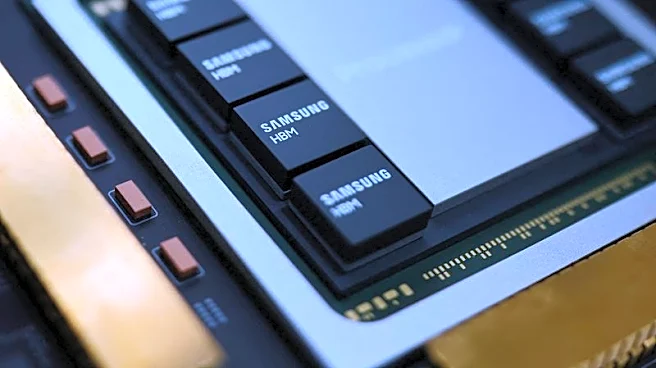
Cathie Wood, CEO of Ark Invest, has stated that her firm is avoiding investments in major memory-dependent artificial intelligence (AI) chip stocks, including companies like Samsung Electronics Co. Ltd., SK Hynix Inc., and Micron Technology Inc. Wood views
high-bandwidth memory as the most cyclical and commoditized segment of the semiconductor industry. She argues that the current high prices for memory, which J.P. Morgan estimates could rise over 400% from 2024 to 2026, are not a normal state and should be seen as a negative indicator. Instead, Ark Invest is focusing on companies like Cerebras and Groq, which are developing AI chips that do not require high-bandwidth memory. This strategy is reflected in Ark's recent trades, which include selling Advanced Micro Devices, Inc. shares and purchasing Cerebras stock.
Why It's Important?
This stance from a prominent investor like Cathie Wood highlights a significant debate within the semiconductor industry regarding the sustainability of current memory chip prices and the future direction of AI chip development. Her perspective suggests a potential shift in investment focus away from traditional memory manufacturers towards innovative AI chip designs that aim to reduce reliance on high-bandwidth memory. If more investors adopt this view, it could impact the stock performance and market valuations of major memory producers. The concept of 'chipflation,' where rising chip prices drive up costs for everyday electronics, underscores the broader economic implications of the semiconductor market. The industry's response to these pricing dynamics, particularly the call from SK Group Chairman Chey Tae-won to prioritize supply expansion over profit maximization, indicates a recognition of the need for market stability.
What's Next?
The semiconductor industry will likely continue to grapple with the tension between high memory prices and the need for increased supply. While Samsung, SK Hynix, and Micron are expanding production, significant supply relief is not anticipated until 2028 at the earliest, according to Counterpoint Research Director MS Hwang. This extended period of potential scarcity could further fuel 'chipflation' and prompt more companies to explore alternative AI chip architectures that are less dependent on high-bandwidth memory, as advocated by Cathie Wood. The market will be watching to see if other investment firms follow Ark Invest's lead in divesting from memory-heavy semiconductor stocks. Additionally, the long-term customer agreements, such as those signed by Micron, will be crucial in determining the stability and future revenue streams for memory manufacturers amidst these evolving market dynamics.
Beyond the Headlines
The debate over memory chip dependency in AI extends beyond immediate market fluctuations, touching upon fundamental aspects of technological innovation and supply chain resilience. Wood's comparison to Tesla engineering cobalt out of its batteries suggests a broader trend in the tech industry: actively designing around potential supply chain bottlenecks and commoditized components. This approach could lead to more diversified and resilient AI hardware ecosystems, reducing vulnerability to price volatility and supply shortages in specific components. The emphasis on AI chips that 'do not require high bandwidth memory' could spur significant research and development into novel chip architectures and processing methods. This strategic shift could ultimately redefine the competitive landscape of the AI hardware market, favoring companies that can innovate to reduce reliance on traditionally cyclical and commoditized components.