






What's Happening?
Directors Phil Lord and Chris Miller, known for their involvement in the upcoming 'Project Hail Mary' film, are seeing their work extend into the mixed-reality (MR) gaming space. Maze Theory, a London-based studio, is developing 'Project Hail Mary: Journey
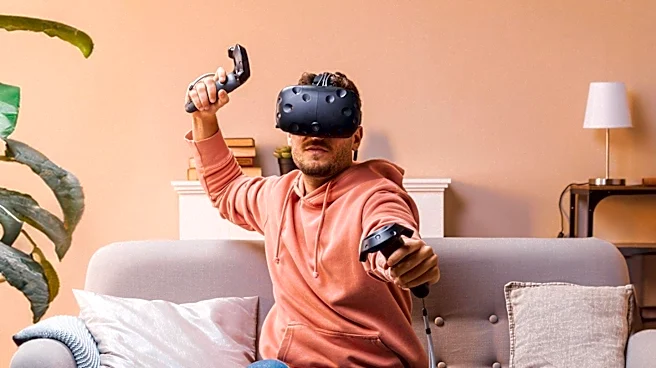
Among the Stars,' a VR game confirmed for release in late 2026 on Meta Quest 3, Meta Quest 3S, and Pico 4. This game is not a direct adaptation of the book or the film but an original narrative chapter written by Andy Weir, the author of the 'Project Hail Mary' novel. The game utilizes hand-tracking technology, allowing players to use gestures, such as the 'jazz hands' greeting, to communicate with the alien co-protagonist, Rocky. This interaction method is central to the game's cooperative problem-solving mechanics and reflects Rocky's in-universe communication through vibration and movement. The MR format integrates digital objects into the player's physical space, with the spacecraft's failing systems appearing within the player's room, demanding physical interaction to diagnose and solve problems.
Why It's Important?
The development of 'Project Hail Mary: Journey Among the Stars' signifies a growing trend in the entertainment industry where major film properties are expanding into interactive mixed-reality experiences. This move leverages the immersive capabilities of VR and MR technologies to offer fans a new way to engage with beloved stories and characters. For the U.S. entertainment and technology sectors, this represents a significant investment in the future of interactive media, potentially driving innovation in game design and hardware development. The game's emphasis on physical gestures and cooperative problem-solving could set new standards for VR gameplay, moving beyond passive consumption to active, embodied interaction. This could attract a broader audience to VR platforms, boosting sales for companies like Meta and Pico, and creating new revenue streams for content creators. Furthermore, the involvement of original author Andy Weir in crafting a new narrative specifically for VR highlights the potential for these platforms to become legitimate storytelling mediums, not just secondary adaptations.
What's Next?
The mixed-reality game 'Project Hail Mary: Journey Among the Stars' is slated for a global launch in late 2026. Fans can currently wishlist the game on Meta Quest platforms, with further details regarding pricing and additional platform availability expected before the end of 2026. The success of this title could influence future decisions by film studios and game developers regarding the integration of VR and MR experiences with major intellectual properties. As hand-tracking fidelity on devices like the Meta Quest 3 continues to improve, the effectiveness of gesture-based controls in games will be closely watched. The reception of this original VR narrative, written by Andy Weir, will also be a key indicator of how audiences respond to expanded universe content delivered through immersive technologies. The game's performance could pave the way for more original stories and interactive experiences tied to popular films and books.
Beyond the Headlines
This venture into mixed-reality gaming for 'Project Hail Mary' underscores a broader shift in how narratives are consumed and experienced. It blurs the lines between traditional media (books, films) and interactive digital platforms, suggesting a future where stories are not confined to a single format but are instead expansive, multi-platform universes. The use of 'jazz hands' as a core communication mechanic in the game highlights the potential for VR to create unique, non-verbal forms of interaction that are deeply integrated into the narrative, moving beyond conventional button presses or joystick movements. This could lead to a re-evaluation of how accessibility and immersion are designed in games, fostering more intuitive and physically engaging experiences. Ethically, as MR technology becomes more sophisticated, questions about the blending of digital and physical realities, and the potential impact on user perception and interaction with their real-world environment, may become more prominent. This project serves as an early example of how these new technological frontiers are being explored in mainstream entertainment.