



What's Happening?
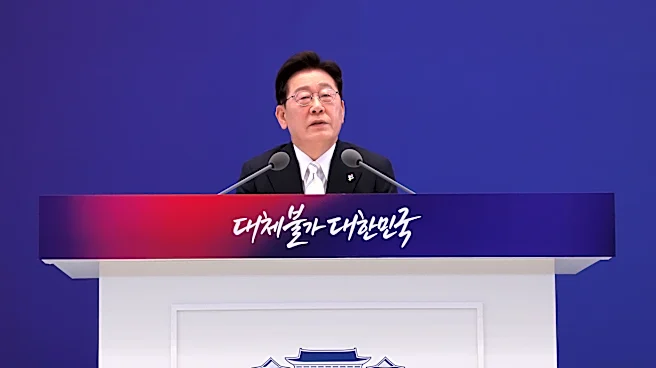
South Korean President Lee Jae Myung has emphasized the necessity of a fundamental shift in the country's economic growth model. Speaking at a meeting with senior presidential secretaries and aides at Cheong Wa Dae on 'Small Business Day,' President Lee stated
that the South Korean economy needs to move beyond quantitative expansion to achieve a qualitative leap forward. He articulated a vision for South Korea to become a 'giant startup incubator' and foster an 'era of national entrepreneurship,' where all citizens are primary drivers of growth. President Lee highlighted that the existing system, where quantitative growth directly led to job creation and social advancement, has reached its limits due to the rapid restructuring of the employment structure by advancements in artificial intelligence and robotics. He stressed the importance of transitioning to an entrepreneurial society where diverse economic players create new markets.
Why It's Important?
President Lee Jae Myung's call for a fundamental shift in South Korea's economic model is significant for its potential to reshape the nation's industrial landscape and global competitiveness. By focusing on becoming a 'startup incubator' and fostering 'national entrepreneurship,' South Korea aims to adapt to the challenges posed by technological advancements like AI and robotics, which are altering traditional employment structures. This strategy could lead to increased innovation, job creation in new sectors, and a more resilient economy less dependent on established industries. For U.S. businesses and investors, this shift could present new opportunities for collaboration, investment in South Korean startups, and market entry into a dynamically evolving economy. Conversely, it could also intensify competition in tech and innovation sectors. The success of this initiative will depend on effective policy implementation, including curriculum improvements, expanded financial support, and regulatory innovation, which could serve as a model for other developed nations facing similar economic transitions.
What's Next?
President Lee Jae Myung has called for pooling national capabilities into curriculum improvements, expanded financial support, and regulatory innovation to facilitate this economic transformation. The government plans to build a system that encourages individuals with ideas and technology to pursue entrepreneurship, providing support even in cases of failure. A multi-layered support system encompassing finance, technology, and market channel development is envisioned to help promising startups grow into global enterprises. The implementation of these policies will be crucial in determining the success of South Korea's transition to an entrepreneurial society. Future legislative actions and government programs are expected to focus on creating a more favorable environment for startups and fostering innovation across various sectors.
Beyond the Headlines
The emphasis on a 'startup incubator' model reflects a broader global recognition that traditional economic growth engines are becoming insufficient in the face of rapid technological change. This shift has profound implications for education systems, labor markets, and social safety nets. It suggests a move away from a job-for-life mentality towards a more dynamic, entrepreneurial workforce, requiring continuous learning and adaptability. Ethically, it raises questions about equitable access to entrepreneurial opportunities and support, ensuring that the benefits of this new growth model are widely distributed and do not exacerbate existing inequalities. Culturally, it may necessitate a shift in societal attitudes towards risk-taking and failure, viewing them as integral parts of the innovation process rather than deterrents. The long-term success of such a model will depend on its ability to create inclusive growth and provide robust support systems for all citizens.