







What's Happening?
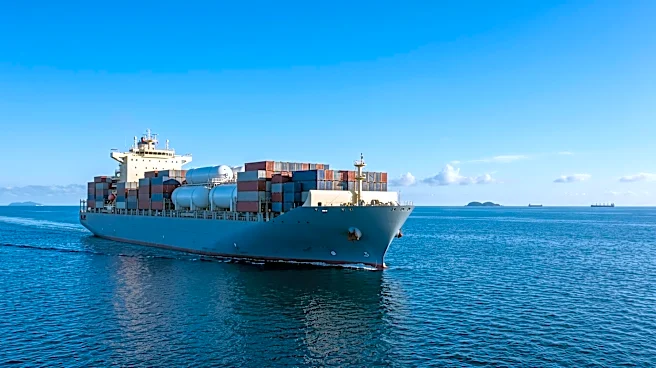
Laura DiBella, a Commissioner with the U.S. Federal Maritime Commission (FMC), is advocating for a re-evaluation of the International Maritime Organization's (IMO) Net-Zero Framework (NZF). The NZF aims to achieve net-zero greenhouse gas emissions from
ships by 2050. DiBella argues that the current framework raises more questions than it answers and needs to be rethought before international acceptance and implementation. Her primary concern is that the NZF attempts to move shipping away from the global petroleum system through regulation rather than market forces, potentially limiting alternative fuel sources. She emphasizes that any viable proposal must allow for a maximum range of alternate fuel sources, specifically including LNG and bio-LNG, to ensure affordability, global availability, and scalability for the shipping industry.
Why It's Important?
This call to rethink the IMO's Net-Zero Framework has significant implications for the U.S. maritime industry and global trade. The U.S. is a leading exporter of LNG, and its inclusion as a recognized alternative fuel in international shipping regulations could provide a substantial economic boost. If the NZF restricts fuel options, it could lead to increased costs for U.S. shipping companies and consumers, as these costs would likely be passed on through higher freight rates. Conversely, a framework that embraces a wider array of alternative fuels, including bio-LNG, could foster innovation and investment in U.S. fuel production and infrastructure. The debate highlights the tension between ambitious environmental goals and the practical realities of global supply chains and economic viability, directly impacting U.S. competitiveness in the international shipping sector.
What's Next?
The discussion around the IMO's Net-Zero Framework is expected to continue, with U.S. representatives likely pushing for a more inclusive approach to alternative fuels. The FMC Commissioner's stance suggests that the U.S. will advocate for policies that recognize market-proven fuels like bio-LNG and leverage existing infrastructure. This could lead to further negotiations and revisions of the NZF to accommodate a broader range of fuel options. The maritime industry, both in the U.S. and globally, will be closely watching these developments, as the final framework will dictate future investment in vessel technology, fuel production, and supply chain logistics. The outcome will determine the economic feasibility of achieving net-zero emissions for shipping and its impact on global trade costs.
Beyond the Headlines
The debate over the IMO's Net-Zero Framework touches upon deeper issues of energy security, technological readiness, and international regulatory harmonization. By emphasizing market forces and fuel diversity, Commissioner DiBella's argument implicitly challenges the notion of top-down regulatory mandates that might overlook practical economic and logistical constraints. This perspective highlights the complex interplay between environmental policy and economic realities, particularly for an industry as globally interconnected as shipping. The outcome could set a precedent for how international bodies approach decarbonization in other sectors, influencing the balance between environmental ambition and economic pragmatism. It also underscores the strategic importance of energy resources, like U.S. LNG, in the global transition to lower-carbon economies.