




What's Happening?
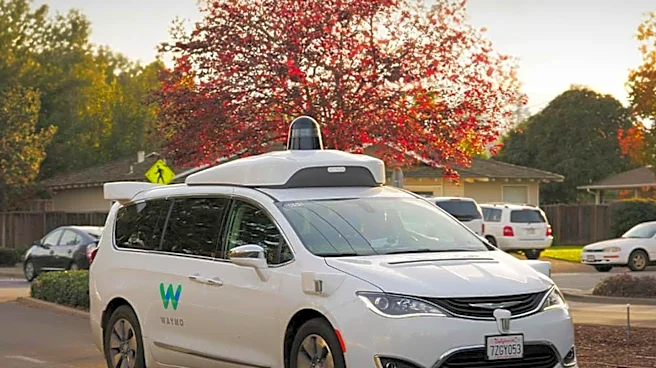
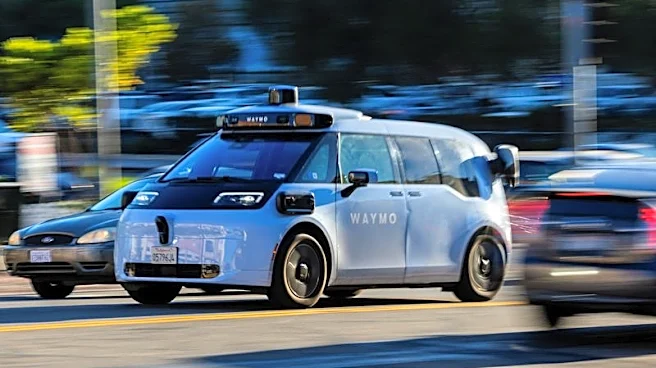
Waymo, a subsidiary of Alphabet ($GOOGL), has issued a software recall for its robotaxi fleet following two incidents where vehicles exhibited problematic behavior. The recall addresses issues where robotaxis drove into a closed lane and responded inadequately
to a traffic controller's hand signals. This action comes after the California Public Utilities Commission (CPUC) ordered a halt to Waymo's expansion in San Francisco just weeks prior due to safety concerns. The software update aims to correct these specific malfunctions, improving the robotaxis' ability to interpret road conditions and human traffic signals accurately. This recall underscores the ongoing challenges and necessary refinements in the development and deployment of autonomous vehicle technology, particularly concerning safety and interaction with dynamic environments.
Why It's Important?
This software recall is important as it highlights the critical safety challenges and regulatory scrutiny faced by the autonomous vehicle industry. Incidents involving lane infractions and inadequate responses to human signals can undermine public trust and lead to stricter regulations, potentially slowing the widespread adoption of robotaxi services. The CPUC's prior order to halt Waymo's expansion in San Francisco demonstrates the heightened regulatory environment and the need for autonomous vehicle companies to prioritize safety and reliability. For Waymo, addressing these issues promptly through a recall is crucial for maintaining its operational licenses and regaining public and regulatory confidence. The incident also emphasizes the complexity of programming autonomous vehicles to handle unpredictable real-world scenarios, especially those involving human interaction and dynamic road closures, which are vital for safe integration into urban environments.
What's Next?
Waymo will implement the software update across its robotaxi fleet to rectify the identified issues. The effectiveness of this update will be closely monitored by both Waymo and regulatory bodies like the CPUC. Successful resolution of these problems could potentially lead to the lifting of expansion restrictions and a renewed push for broader deployment. However, any further incidents could result in more severe regulatory actions, including fines or additional operational limitations. The company will likely continue to refine its AI and sensor technology to better anticipate and react to complex traffic situations and human cues. This recall serves as a reminder that the path to fully autonomous driving is iterative, requiring continuous testing, data analysis, and software improvements to ensure safety and reliability.
Beyond the Headlines
The Waymo software recall delves into the deeper implications of artificial intelligence in safety-critical applications. The incidents reveal the inherent difficulties in translating human intuition and complex environmental understanding into algorithmic decision-making for autonomous systems. The challenge extends beyond mere technical fixes to encompass the philosophical question of how much autonomy can be granted to machines in unpredictable human-centric environments. This event could influence future regulatory frameworks, potentially leading to more stringent testing protocols and certification requirements for autonomous vehicle software. It also highlights the ongoing debate about the balance between innovation and public safety, and how quickly autonomous technology should be integrated into daily life. The public's perception of robotaxi safety will be heavily influenced by how effectively Waymo and other companies address such incidents, shaping the long-term trajectory of the autonomous vehicle industry.