







What's Happening?
HEX20, an Indian space-tech startup, has signed a Multi-Launch Agreement (MLA) with Skyroot Aerospace for its Earth-observation constellation and in-orbit payload demonstration missions. This agreement involves HEX20 purchasing three dedicated launches
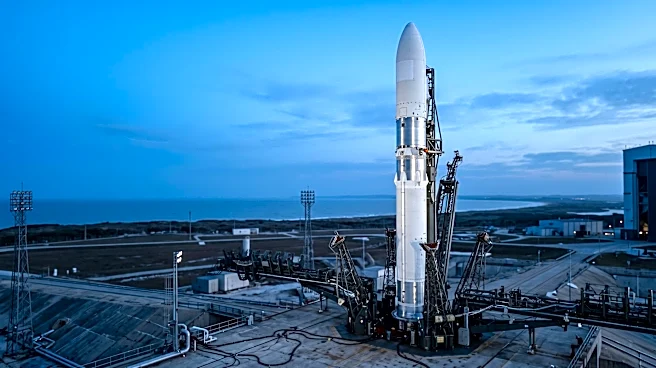
from Skyroot Aerospace, scheduled to commence in Q4 2027. These missions will utilize Skyroot's Vikram series of launch vehicles and will support HEX20's spacecraft missions, while also offering rideshare opportunities for third-party spacecraft. This collaboration combines Skyroot's launch capabilities with HEX20's expertise in spacecraft engineering, payload integration, ground operations, and mission delivery. HEX20 has also recently launched its second satellite, KOYO, for Taiwan’s National Central University aboard SpaceX’s Transporter-17, and its maiden satellite Nila with SpaceX. The company, with operations in the US, UAE, and Taiwan, specializes in building payload-agnostic satellite platforms and providing satellite mission-as-a-service and payload hosting capabilities.
Why It's Important?
This multi-mission launch agreement signifies a crucial step in the maturation of India's private space ecosystem. The collaboration between HEX20 and Skyroot Aerospace demonstrates a growing trend of private companies taking on more comprehensive roles in space activities, moving beyond traditional government-dominated models. For the U.S. space industry, this development highlights increasing global competition and opportunities for partnerships. As Indian private companies like HEX20 expand their capabilities and reach, they become potential collaborators or competitors in the international space market, particularly in areas like Earth observation and satellite services. The ability of Indian startups to secure multi-launch agreements and participate in international missions, such as HEX20's work with SpaceX, indicates a shift in the global space landscape, potentially influencing pricing, innovation, and access to space for various stakeholders, including U.S. entities. This also underscores the effectiveness of policy reforms in India that have encouraged private sector participation, creating a more dynamic and competitive global space economy.
What's Next?
The first of the three dedicated launches under the MLA is slated for Q4 2027, which will be a key milestone for both HEX20 and Skyroot Aerospace. These missions will further HEX20's Earth-observation constellation and in-orbit payload demonstrations, potentially leading to new data services and technological advancements. The success of these launches could attract more international customers for both companies, solidifying India's position as a significant player in the global commercial space market. Additionally, the ongoing collaboration between Indian private space companies and international partners, such as HEX20's work with the UAE Space Agency and SpaceX, suggests a future with more integrated global space missions and supply chains. This could lead to increased cross-border investments and technological exchanges, further accelerating innovation in the space sector. The continued growth of India's private space sector will likely prompt other nations, including the U.S., to assess their own strategies for fostering private sector involvement and maintaining competitiveness in the evolving space economy.
Beyond the Headlines
This partnership reflects a broader global trend of democratizing access to space and fostering a more diverse space economy. Historically, space exploration and utilization were primarily the domain of government agencies. However, the rise of private companies like HEX20 and Skyroot Aerospace, supported by policy changes, is transforming this paradigm. This shift has profound implications, including potentially lowering the cost of space access, accelerating technological innovation, and creating new commercial opportunities. The ability of private entities to undertake complex missions, from satellite development to launch services, could lead to a more resilient and distributed space infrastructure. Furthermore, the focus on Earth observation and in-orbit demonstrations by companies like HEX20 suggests a future where space-derived data and services play an even more integral role in addressing global challenges, from climate monitoring to resource management, with a wider array of actors contributing to these efforts.